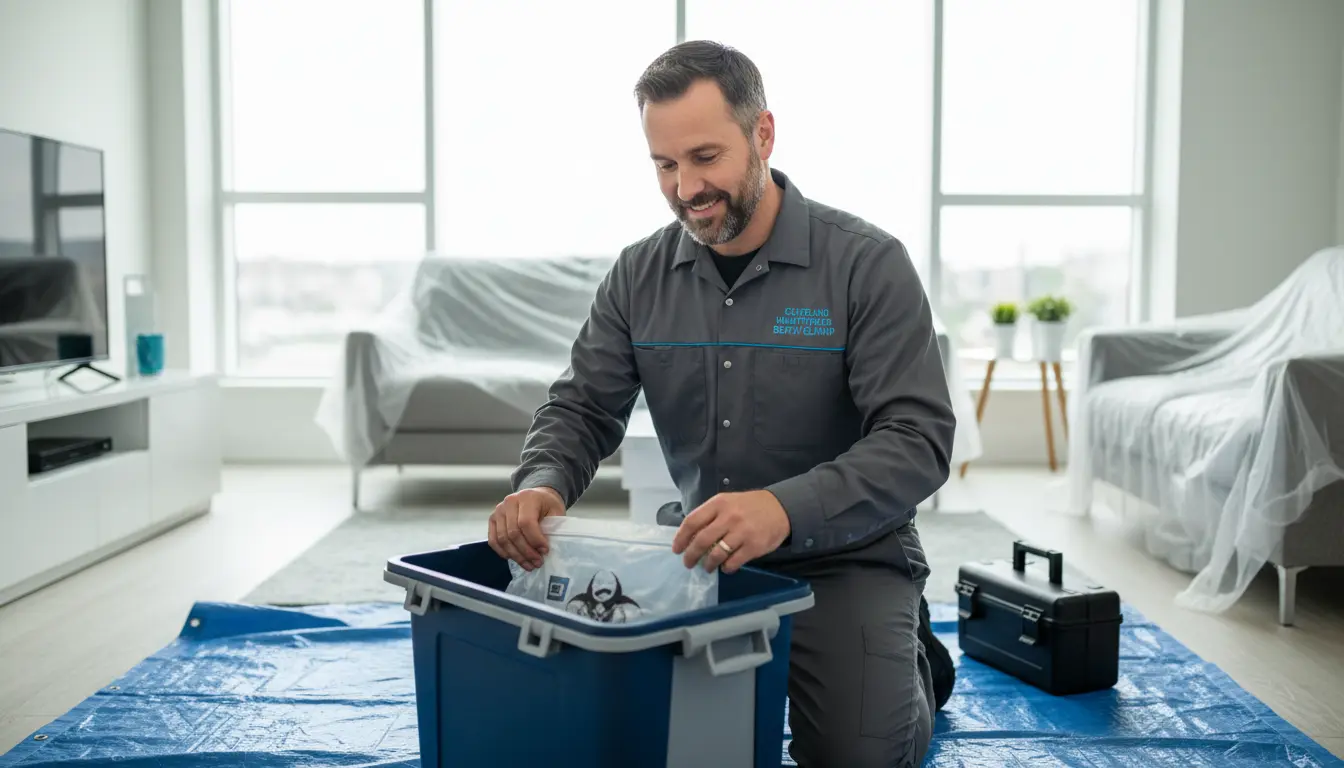
Unattended death cleanup is not janitorial work. It is a regulated, scientific process governed by OSHA’s Bloodborne Pathogens Standard (29 CFR 1910.1030), EPA waste disposal regulations, and the IICRC S540 standard for trauma and crime scene cleanup. Every step is designed to eliminate biological hazards, restore the structure to a safe condition, and prevent cross-contamination to surrounding rooms or HVAC systems. In Cleveland, where historic homes with porous materials are common, the technical demands are even higher. Understanding what happens during a professional unattended death cleanup process helps property owners make informed decisions quickly—and avoid costly mistakes that can lead to long-term health risks and property devaluation.
Cleveland Unattended death cleanup is the premier local provider for this exact service. Our technicians are certified, insured, and equipped to handle the most complex scenarios, from single-room incidents to full-house remediations. Below, we walk through every phase of the process so you know exactly what to expect—and why professional intervention is non-negotiable.
Initial Risk Assessment and Scene Stabilization
The first step on-site is a thorough risk assessment. Our crew arrives in a marked response vehicle stocked with industrial-grade negative air machines, hospital-grade disinfectants, PPE, and forensic cleaning tools. Before anyone enters the scene, we establish a controlled perimeter. This involves sealing doorways with plastic sheeting and creating a negative pressure zone to prevent airborne contaminants from escaping into other parts of the building. In Cleveland’s humid climate, where decomposition fluids can become aerosolized more easily, this containment step is critical.
We then conduct a visual and olfactory evaluation to map the extent of the biohazard. Using adenosine triphosphate (ATP) testing, we measure biological residue on surfaces even where no visible stain exists. This scientific method detects organic matter that standard cleaning would miss. The ATP readings inform our cleaning strategy—areas with high readings require multiple passes and enzyme-based treatments. We also check for structural damage: fluid seepage into subfloors, wicking up drywall, or saturating baseboards. In a recent job in Detroit Shoreway, we discovered that biological fluids had traveled along a heating duct, contaminating an adjacent bedroom. That level of detection only comes from trained eyes and proper instrumentation.
Once the assessment is complete, we document everything with photographs and notes for the insurance claim and legal record. This documentation also helps us plan the specific sequence of removal and cleaning, which we adjust based on local conditions like temperature and humidity. For a detailed look at the full workflow, see our step by step unattended death cleanup process explained.
Personal Protective Equipment and Biohazard Removal
Our technicians don full-body Tyvek suits, rubber boots, double-layered nitrile gloves, and P100 respirators. Every seam is taped. This is not optional—bloodborne pathogens like hepatitis B, hepatitis C, and HIV can survive on surfaces for weeks. Even dried fluids can become reaerosolized during cleanup. The PPE protocol is designed to eliminate any skin or mucous membrane exposure.
Physical removal begins with the most contaminated items: bedding, carpets, upholstery, and any porous materials that cannot be effectively decontaminated. These are placed in red biohazard bags and sealed according to Ohio EPA regulations. For hard surfaces like hardwood floors, we use a combination of mechanical scraping and absorbent compounds to lift bulk fluids. In many Cleveland homes, original hardwood floors have gaps that allow liquids to pool underneath. We often need to remove sections of flooring to access the subfloor. If the subfloor is saturated, it must be cut out and replaced—cleaning alone cannot restore structural integrity after prolonged exposure to decomposition fluids.
All waste is transported to a licensed medical waste incinerator. We never dispose of biohazardous material in regular trash or municipal sewers. This compliance protects everyone downstream. For a deeper look at the dangers involved, read our article on top dangers of unattended deaths in Cleveland OH.
Structural Decontamination and Microbial Remediation
After bulk removal, the real chemical work begins. We apply EPA-registered hospital-grade disinfectants that are proven to inactivate a broad spectrum of pathogens, including enveloped viruses and bacteria. These chemicals are left on surfaces for a specific dwell time—usually 10 to 15 minutes—to ensure complete kill. We do not use household bleach, which is ineffective against many pathogens when organic matter is present and can damage surfaces over time.
Next, we treat affected areas with specialized enzyme cleaners that break down residual organic proteins and fatty acids. This step is essential for eliminating odors at the molecular level, not just masking them. We also use hydroxyl generators and ozone machines to neutralize volatile organic compounds (VOCs) that cause lingering smells. In homes with forced-air heating, we clean and disinfect the ducts to prevent recirculation of contaminated air. If the HVAC system was exposed to bioaerosols, we may recommend professional duct cleaning by an NADCA-certified company.
Throughout the process, we conduct multiple rounds of ATP testing to verify that biological residue has been reduced to acceptable levels. A reading below 10 relative light units (RLU) is considered clean for most residential surfaces. We do not leave the site until every area passes this threshold. This commitment to scientific verification is what separates professional remediation from superficial cleaning.
Data Comparison: Professional vs. Standard Cleaning
| Feature / Metric | Professional Biohazard Remediation | Standard Residential Cleaning |
|---|---|---|
| Regulatory Compliance | OSHA 29 CFR 1910.1030, EPA waste rules, IICRC S540 | None |
| Pathogen Elimination | Hospital-grade disinfectants with verified dwell times; ATP testing | Household cleaners; no verification |
| Structural Assessment | Full inspection for hidden seepage, subfloor damage, HVAC contamination | Visual only; no moisture or biological testing |
| Odor Removal | Enzyme treatments, hydroxyl/ozone, duct cleaning | Air fresheners or bleach (ineffective) |
| Waste Disposal | Licensed medical waste incineration | Regular trash (illegal and dangerous) |
Source: IICRC S540 Trauma and Crime Scene Cleanup Standard
Expert Insights: Three Diagnostic Tips and Common Mistakes
Diagnostic Tip 1: Detect Hidden Biological Seepage with Moisture Meters
Biological fluids are mostly water. When they seep into porous materials like drywall or wood, they increase the moisture content. Using a pin-type moisture meter, we can identify areas that look dry but are actually saturated beneath the surface. This is especially important in older Cleveland homes where plaster and lath can wick fluids far from the original spill. If we find elevated moisture readings, we probe further and often discover hidden contamination that would otherwise be missed.
Diagnostic Tip 2: Porous Materials Require Replacement, Not Cleaning
Many property owners assume that a good scrubbing can salvage a stained mattress or carpet. In reality, porous materials act like sponges. They trap biological material deep within their fibers or foam core. Even after surface cleaning, pathogens and odors persist. The IICRC standard mandates removal and disposal of any porous item that has been in direct contact with blood or bodily fluids. Attempting to clean these items is a waste of time and a health risk.
Diagnostic Tip 3: Negative Pressure Prevents Cross-Contamination
When we set up an air scrubber with HEPA filtration and exhaust it outside, we create negative pressure inside the work area. This ensures that any airborne particles—including fungal spores from decomposition—are drawn into the machine, not into adjacent rooms. Without this setup, contaminants can travel through door gaps, ductwork, and even elevator shafts in multi-unit buildings. We always use negative pressure for any unattended death that has been undiscovered for more than 24 hours.
Common Mistake 1: Using Household Bleach on Biological Matter
Bleach is a disinfectant, but it is inactivated by organic material. If you pour bleach on a pool of blood, the bleach reacts with the proteins and becomes neutralized before it can kill pathogens. Worse, bleach can damage surfaces and release toxic chlorine gas when mixed with other cleaners. Professional remediation uses disinfectants specifically formulated for use on organic soils.
Common Mistake 2: Waiting for Odor to Dissipate Naturally
Decomposition odors are not just unpleasant—they are evidence of ongoing microbial activity and potential airborne pathogens. Waiting days or weeks for the smell to fade allows bacteria and fungi to proliferate and spread. By the time the odor becomes noticeable to neighbors, the contamination may have migrated to multiple rooms. Immediate professional intervention is the only safe response.
Common Mistake 3: Allowing Untrained Personnel into the Site
Family members, well-meaning friends, or even general contractors often enter the scene before cleanup begins. Every person who walks through a biohazard zone risks exposure and can track contaminants outside. We recommend sealing the room and contacting a certified remediation company immediately. For more signs that professional help is needed, check 5 signs you need professional death cleanup services.
Pricing Factors for Unattended Death Cleanup in Cleveland
Pricing for professional unattended death cleanup varies based on several concrete factors. Here are the most common cost components:
- Site mobilization fee: A flat fee covers the cost of dispatching a crew, transportation of equipment, and initial assessment. In Cleveland, this typically ranges from $200 to $500 depending on distance and time of day.
- Hourly remediation rates: Most companies charge an hourly rate per technician. Rates between $125 and $200 per hour are typical. A moderate single-room incident often takes 4 to 8 hours. Severe cases involving multiple rooms or advanced decomposition can take 20 hours or more.
- Waste disposal costs: Biohazard waste must be incinerated at a licensed facility. Disposal fees are usually calculated by weight or per container. This can add $200 to $800 to the total.
- Material replacement: If subflooring, drywall, or insulation must be removed and replaced, those costs are separate. A small patch of subfloor might cost $300 to $500, while full room reconstruction can run thousands.
- HVAC decontamination: If the heating or cooling system was contaminated, cleaning ducts and coils adds $500 to $1,500.
Most insurance policies cover unattended death cleanup under property damage or liability clauses. We work directly with adjusters to provide detailed documentation and estimates. For a comprehensive overview of what to expect financially, see our ultimate guide to biohazard cleanup after death.
Safety and Standards: Certifications and Protocols
Professional unattended death cleanup is not a service that can be performed without proper training and certification. Every technician at Cleveland Unattended death cleanup holds current certifications in bloodborne pathogen training (OSHA-compliant), IICRC trauma and crime scene remediation (S540), and hazardous waste handling. We carry commercial liability insurance and workers’ compensation to protect both our crew and the property owner.
Our protocols follow the hierarchy of controls: elimination of the hazard (removal of contaminated materials), engineering controls (negative pressure, HEPA filtration), administrative controls (written safety plans, decontamination zones), and personal protective equipment. We also use a three-stage decontamination process for tools and equipment before they leave the site. This prevents cross-contamination to other jobs or to our vehicle.
We coordinate with local authorities in Cuyahoga County for waste tracking and disposal manifests. Every biohazard load is documented with a chain of custody from the property to the incinerator. This level of accountability is required by law and gives property owners peace of mind. For more on why local expertise matters, read why Cleveland trusts experts for death scene cleanup.
Frequently Asked Questions
How long does the cleanup process typically take?
The duration depends on the size of the affected area and the stage of decomposition. A single small room with minimal fluid migration can be completed in 4 to 6 hours. Larger scenes or those where fluids have spread through multiple rooms, ducts, or floors can take 1 to 3 days. We always provide a time estimate after the initial assessment and update you throughout the process.
Is it safe to stay in the home during cleanup?
In most cases, we recommend that occupants vacate the area during active remediation, especially if negative pressure containment is in use. The noise from air scrubbers and the presence of chemical vapors can be disruptive. However, if only one room is affected and the rest of the home is not connected by HVAC, it may be possible to remain in other parts of the house. We will advise you based on the specific conditions of your property.
Will the smell ever fully go away?
Yes, when proper remediation techniques are applied. Odor molecules are volatile organic compounds that can be neutralized through a combination of enzyme cleaning, hydroxyl generation, and ozone treatment. We also treat porous materials that may have absorbed odors. After our process, independent air quality testing confirms that no residual odors remain. In rare cases where odors have penetrated structural wood deeply, we may recommend sealants or encapsulation.
Do you handle the paperwork for insurance claims?
Absolutely. We provide a detailed scope of work, photographs, ATP test results, and waste disposal manifests. We can communicate directly with your insurance adjuster to explain the technical necessity of each step. Many claims are approved more quickly when the cleanup company provides professional documentation. If you are unsure about coverage, we recommend reading what to do after discovering an unattended death for guidance on the first steps.
What happens if I try to clean it myself?
Self-cleaning is strongly discouraged due to health risks and legal liability. Without proper training, you risk exposure to bloodborne pathogens and respiratory hazards. You may also fail to remove all biological material, leading to persistent odors, insect infestations, and potential legal issues if a future occupant becomes ill. Additionally, improper disposal of biohazard waste is a violation of Ohio EPA regulations and can result in fines. Professional cleanup is not just safer—it is the only legal and responsible option.
Professional Biohazard Remediation in Cleveland
Unattended death cleanup is one of the most technically demanding services in the restoration industry. It requires a combination of scientific knowledge, regulatory compliance, and compassion for families going through a difficult time. In Cleveland, where the climate and building stock present unique challenges, hiring a local expert who understands these variables is essential. From the initial containment to the final ATP test, every step of the process is designed to restore safety and peace of mind.
Cleveland Unattended death cleanup has the training, equipment, and experience to handle any unattended death scenario. We serve all neighborhoods including Bay Village, Little Italy, Slavic Village, Detroit Shoreway, Hough, Brooklyn, Garfield Heights, Maple Heights, and the greater Cuyahoga County area. Our team is available 24/7 for emergency response. If you are facing an unattended death situation, do not hesitate to contact us. We will handle the cleanup with the professionalism and discretion you deserve.