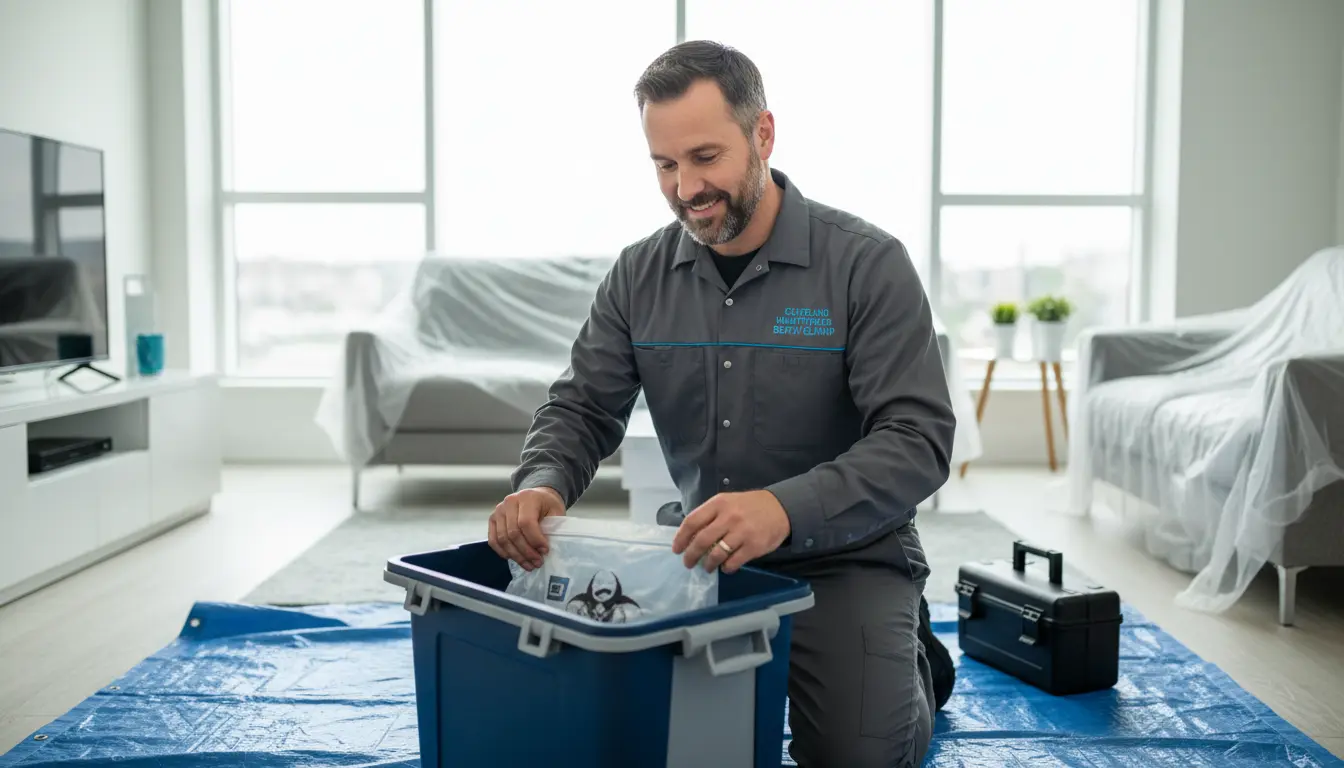
“The odor hit me before the door was fully open,” recalled Mike, a veteran biohazard remediation supervisor for Cleveland Unattended Death Cleanup. He was standing outside a rental property in Garfield Heights, a solid but aging brick bungalow that had sat sealed for nine days through a July heatwave. The tenant’s family had called after unanswered phone calls, and the coroner had already removed the remains. Now Mike’s job was to assess how much the unattended death cleanup would cost—and, more importantly, to restore the home so it could be safely reoccupied. The temperature inside was pushing 85°F, and the humidity hovered around 70%. The biological fluids had already seeped through the carpet pad into the 100-year-old hardwood subfloor. This wasn’t a simple clean; it was a forensic restoration project requiring structural decontamination, microbial remediation, and the kind of specialized equipment most Cleveland property owners have never seen.
Unattended death cleanup costs in Cleveland in 2026 vary widely, but the average residential remediation for a single room with moderate decomposition typically runs between $3,500 and $7,000. However, the final price tag depends on factors like the duration of decomposition, square footage affected, and the type of surfaces involved. For Mike, that Garfield Heights property quickly escalated when his team discovered that the fluids had migrated under the baseboards and into the wall cavity, requiring partial drywall removal and full HVAC decontamination. The total estimate came to $6,800. That number is not unusual for Cleveland’s Northeast Ohio market, where the combination of Great Lakes–effect humidity and aging residential architecture creates unique challenges for unattended death cleanup crews.
Why Cleveland’s Climate Makes Unattended Death Cleanup More Expensive
The Lake Erie shoreline is a blessing for summer recreation, but it’s a nightmare for biohazard remediation. Cleveland’s humidity levels, especially from June through September, accelerate biological decomposition dramatically. A body that might take two weeks to reach advanced decay in a dry climate can achieve the same stage in just five days in a humid, warm Cleveland apartment. This rapid decomposition means more extensive fluid migration, faster odor penetration into porous materials, and a higher likelihood of structural damage. The cost of unattended death cleanup in Cleveland in 2026 directly reflects the need for aggressive microbial remediation and often complete removal of affected building materials.
Beyond humidity, winter ice management adds logistical costs. When a Cuyahoga County property is discovered during a January freeze, access roads may be icy, and the site itself may require temporary heating to prevent freezing of the water used during cleaning. Crews also need to winterize the structure after remediation to avoid pipe bursts. These seasonal factors are part of why local providers like Cleveland Unattended Death Cleanup factor in site-specific conditions when quoting. For a deeper dive into the regional statistics, check out the stats on unattended deaths and cleanup needs in Ohio, which show that Cuyahoga County accounts for a disproportionate share of these incidents due to its dense urban population and aging housing stock.
The Technical Process Behind Professional Biohazard Remediation
Understanding the step-by-step workflow helps explain why professional unattended death cleanup costs are higher than a standard deep cleaning. The process is governed by the IICRC S540 Standard for Trauma and Crime Scene Cleanup, which requires a systematic approach to ensure pathogen elimination and structural safety. Every technician on Mike’s crew holds OSHA Bloodborne Pathogens certification (29 CFR 1910.1030) and has completed annual refresher training. The first step is always a thorough risk assessment, including air quality monitoring for airborne pathogens and volatile organic compounds (VOCs) released during decomposition.
Once the site is secured, the team suits up in Level C personal protective equipment (PPE), including full-face respirators with HEPA filters, Tyvek suits, and nitrile gloves. The next move is to set up a negative air pressure containment zone using industrial-grade negative air machines. This prevents cross-contamination from spreading to unaffected areas of the home. Mike’s crew uses a minimum of two machines: one to create negative pressure in the contaminated zone and another to exhaust filtered air outside. The containment is critical, especially in Cleveland’s tightly sealed historic homes, where the HVAC system can quickly recirculate airborne contaminants. You can read more about the step-by-step unattended death cleanup process explained to see how each phase is executed.
Physical Removal and Disposal of Biohazardous Waste
All porous materials that have come into contact with biological fluids are removed and disposed of in licensed biohazard waste containers. This includes carpet, padding, drywall below the fluid line, and any wood trim that shows signs of saturation. The removed materials are taken to a permitted medical waste incinerator in Ohio, which adds a disposal fee of roughly $300 to $500 per 55-gallon drum. For a typical Cleveland bedroom, crews often fill two to three drums. The biological waste itself is classified as regulated medical waste, requiring strict chain-of-custody documentation.
After physical removal, the team applies an EPA-registered hospital-grade disinfectant designed to kill bloodborne pathogens, including hepatitis B, C, and HIV. The disinfectant is applied via a low-pressure sprayer and allowed to dwell for the manufacturer’s specified contact time, usually 10 to 15 minutes. Then every surface is wiped down and rinsed with clean water. But the science doesn’t end there. Mike’s crew uses adenosine triphosphate (ATP) testing to verify cleanliness. A handheld luminometer swabs the surface and measures the presence of ATP, which indicates residual biological material. A reading below 10 relative light units (RLUs) is considered passable. If the test fails, the area is recleaned and retested. This level of testing is part of why professional unattended death cleanup costs in Cleveland in 2026 are higher than off-the-shelf cleaning, but it’s the only way to ensure the space is truly safe.
Professional Remediation vs. Standard Janitorial Cleaning: A Data Comparison
The table below illustrates the stark differences between hiring a certified biohazard remediation team and attempting to clean the site with a standard residential cleaning service. The data is based on the IICRC S540 standard and real-world cases handled by Cleveland Unattended Death Cleanup in 2025 and 2026.
| Feature/Metric | Professional Biohazard Remediation | Standard Residential Cleaning |
|---|---|---|
| Regulatory Compliance | OSHA 29 CFR 1910.1030, EPA, DOT, and local Ohio medical waste rules | None; no bloodborne pathogen protocols |
| Pathogen Elimination | EPA-registered disinfectants with validated contact times; ATP testing | Household bleach or general cleaners; no kill verification |
| Structural Assessment | Inspection for fluid migration, mold, and odor penetration; use of moisture meters and borescopes | Visual only; often misses hidden damage |
| Waste Disposal | Licensed medical waste incineration with chain of custody | Landfill dumping of untreated biohazard waste (illegal) |
| Odor Mitigation | Negative air machines, ozone treatment, and hydroxyl generators | Air fresheners or passive ventilation |
| Liability Insurance | Full liability and pollution coverage | Rarely covers biohazard cleanup |
Expert Insights: What Really Drives the Cost
After handling hundreds of unattended death scenes across Cleveland and its suburbs, Mike and his team have identified three diagnostic factors that consistently differentiate a straightforward job from a costly one. The first is hidden biological seepage into wall cavities. When a body decomposes on a bed or sofa, bodily fluids can travel through the padding and mattress, then soak into the floor below. If the floor is concrete, the fluid pools on top. But if it’s wood, as in most Cleveland homes built before 1950, the fluid wicks into the subfloor and can travel horizontally under the baseboards. Detecting this requires a moisture meter and a borescope camera. In many cases, the only remedy is to remove the baseboard and cut out the affected section of subfloor, which adds $800 to $1,500 to the job.
Another common cost driver is the need for specialized HVAC decontamination. The same humidity that accelerates decomposition also causes airborne particles and odors to circulate through the ductwork. Mike’s crew always seals the HVAC vents in the affected room and, if the system has been running, recommends cleaning the entire duct system. This service typically adds $500 to $1,200 depending on the number of vents. The third factor is the presence of existing mold or moisture issues. Cleveland’s older homes often have leaking pipes or basement dampness, and when a death occurs in a room with preexisting mold, the remediation becomes more complex. Mold and biological fluids can interact, creating a secondary microbial contamination that requires targeted antimicrobial treatment.
Common Mistakes Property Owners Make
One of the most frequent errors is using household bleach on biological matter. Bleach is not a reliable disinfectant for bloodborne pathogens in the presence of organic soil; it breaks down quickly and can actually damage surfaces, making it harder to remove stains. A trained technician uses a quaternary ammonium compound or hydrogen peroxide–based disinfectant. Another mistake is waiting for the odor to “air out.” By the time a smell is noticeable down the hall, the porous materials have been deeply contaminated. The odor will never fully dissipate without professional intervention. Finally, allowing untrained family members or property managers into the site violates OSHA safety standards and exposes them to serious health risks, including hepatitis and airborne pathogens. The top dangers of unattended deaths in Cleveland, OH include long-term respiratory issues and structural damage that can lead to full property devaluation.
Pricing Breakdown for Unattended Death Cleanup in Cleveland in 2026
While every job is unique, the following bullet points give a realistic sense of current pricing structures in the Cleveland market. These figures are based on actual quotes from Cleveland Unattended Death Cleanup and reflect the 2026 cost of labor, materials, and disposal.
- Mobilization and assessment fee: $250 to $500. This covers the initial site visit, risk assessment, and a written estimate. It is often waived if the job proceeds.
- Per-hour remediation rate: $150 to $225 per technician per hour. Most jobs require two to four technicians. A typical bedroom cleanup takes 6 to 12 hours of on-site labor combined.
- Disposal of biohazard waste: $75 to $150 per 55-gallon drum. An average scene generates 2 to 4 drums.
- Structural material replacement: $500 to $2,000 depending on square footage of drywall, subfloor, and carpet removed and replaced. This is often subcontracted to a carpentry team.
- HVAC decontamination: $500 to $1,200 for a standard residential system.
- Enzyme treatment for odor control: $300 to $700. These specialized enzymes break down organic residues at the molecular level.
Three factors that most influence the final cost are the volume of biohazardous waste (which correlates with decomposition time), the extent of structural material replacement, and the need for specialized HVAC decontamination. A death that goes undiscovered for two weeks in a humid Cleveland summer will almost always require partial wall removal and duct cleaning, pushing the cost above $7,000. In contrast, a discovery within 24 to 48 hours in a winter months may only require a surface cleaning and odor treatment, costing $2,500 to $4,000.
Safety and Standards: The Foundation of Trust
Every technician working with Cleveland Unattended Death Cleanup holds current IICRC Trauma and Crime Scene Cleanup certification and has completed the OSHA Bloodborne Pathogens Standard training. These certifications are not optional; they are required by law when handling human remains and biological fluids. The practical importance of these standards is immense. For example, the use of proper PPE and containment procedures prevents the spread of bloodborne pathogens like hepatitis C, which can survive for weeks on surfaces. In 2026, the Ohio Department of Health also requires that all biohazard waste be disposed of through a licensed medical waste transporter, which is why our team uses a state-approved incineration facility in Akron.
Beyond compliance, the team follows the IICRC S540 standard for restorative drying and structural decontamination. This includes using HEPA vacuums and negative air pressure to capture airborne particles, as well as performing clearance testing with ATP luminometers. The goal is to return the property to a state that is safe for habitation, as confirmed by third-party testing if required. Property owners who attempt to handle the cleanup themselves or hire an unqualified cleaning crew often face long-term consequences: lingering odors, mold growth hidden behind walls, and potential liability for exposing future tenants to biohazards. The ultimate guide to biohazard cleanup after death explains why these standards are non-negotiable for homes in Cleveland.
Frequently Asked Questions About Unattended Death Cleanup Costs
Does homeowners insurance cover unattended death cleanup in Cleveland?
Most standard homeowners insurance policies do cover the cost of biohazard remediation if the death occurred on the insured property, but it is important to check your policy. Coverage typically falls under the “debris removal” or “other structures” clauses. However, the policy may only reimburse actual costs up to a certain limit, and you may need to use a pre-approved vendor. The property owner should file a claim immediately and document all communication with the insurer. In many cases, the insurance adjuster will require a written estimate from a certified remediation company before approving payment. Cleveland Unattended Death Cleanup provides detailed estimates that can be used for insurance claims.
How long does the unattended death cleanup process take?
For a typical residential room, the active remediation phase takes between 4 and 8 hours of on-site work spread over one to two days. However, the total timeline can extend to three or four days if structural repairs are needed, such as replacing subflooring and drywall, or if the HVAC system requires decontamination. The drying phase for treated surfaces may also require 24 to 48 hours of monitoring with moisture meters. The crew will return for final ATP testing and odor verification before releasing the space. The what to do after discovering an unattended death guide offers a timeline for each step.
Can I clean an unattended death scene myself to save money?
This is strongly discouraged due to the health risks and legal liabilities. OSHA regulations require anyone handling bloodborne pathogens to have proper training and PPE. Without it, you risk exposure to hepatitis B, hepatitis C, HIV, and other infectious diseases. Additionally, improper disposal of biohazard waste is a violation of Ohio environmental laws and can result in fines. While you might save the upfront cost of professional cleanup, the long-term cost of medical treatment or legal penalties far exceeds the typical remediation fee. Moreover, a DIY approach often fails to eliminate odors and hidden contamination, which can reduce the property’s value by thousands of dollars.
What is the typical cost range for a full home cleanup in Cleveland?
For a single-family home where the death occurred in one room and decomposition was caught within a week, the cost ranges from $3,500 to $7,000. If the death went undiscovered for two weeks or more, or if the remains were in a multiple-room area, the cost can climb to $10,000 to $15,000. The most expensive cases involve basements or crawlspaces where fluids have saturated concrete and required professional grinding and resealing. In all scenarios, Cleveland Unattended Death Cleanup offers a free, no-obligation assessment and a transparent quote that includes all anticipated costs. Contact us for a personalized estimate.
Professional Biohazard Remediation in Cleveland
When a family or property manager is faced with the aftermath of an unattended death, the emotional weight is heavy enough without the burden of technical cleanup decisions. The cost of unattended death cleanup in Cleveland in 2026 reflects the real work required to make a home safe again—work that involves science, regulation, and compassion. Mike and his team at Cleveland Unattended Death Cleanup have seen the difference that certified, thorough remediation makes. Homes that were once biohazard zones are restored to their original condition, often with improvements that prevent future issues like mold or odor. Our commitment to the IICRC S540 standard, combined with local knowledge of Cuyahoga County’s building stock and climate, ensures that every property receives the highest level of care. From the initial call to the final ATP test, we are here to help you reclaim your space with dignity and professionalism. If you are dealing with an unattended death situation in Cleveland or any of the surrounding communities we serve, including Bay Village, Little Italy, Slavic Village, and others, reach out to our team. We offer discreet, rapid response and a clear, upfront cost estimate so you can focus on what matters most.