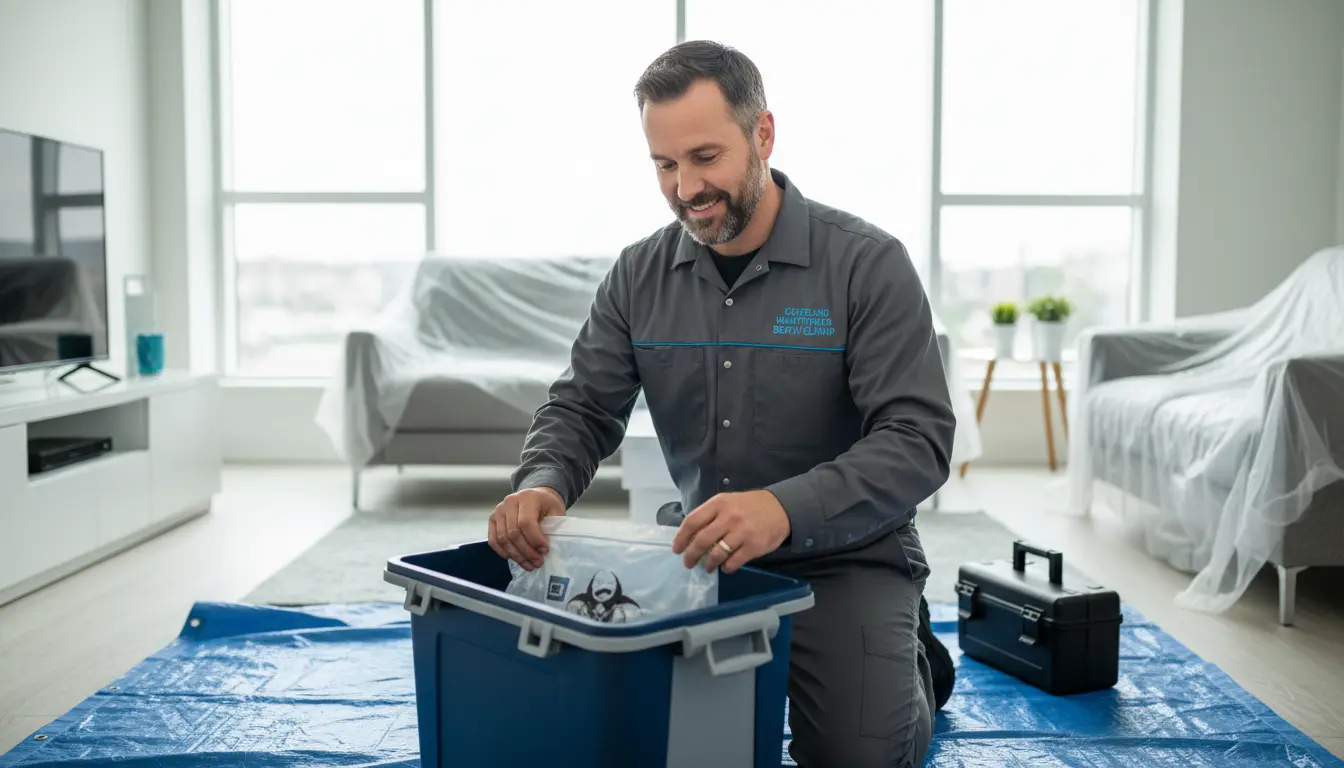
Most people assume that cleaning up after an unattended death is simply a matter of scrubbing harder with bleach. The reality is far more complex—and dangerous. Unattended death cleanup involves biological hazards that penetrate deep into porous materials, HVAC systems, and subflooring, requiring specialized training, equipment, and regulatory compliance that standard cleaning services simply cannot provide. In Cleveland, where historic residential architecture and seasonal humidity create unique challenges, relying on a general cleaning crew can lead to severe health risks, property damage, and legal liability.
Understanding the true scope of biohazard remediation is essential for property owners, landlords, and family members dealing with the aftermath of a traumatic event. This article will dismantle common misconceptions, outline the technical process, and explain why professional remediation is the only safe and effective option—especially for properties in Cuyahoga County. Whether you are managing a rental property in Ohio City or a family home in Shaker Heights, knowing the facts can save you from costly mistakes and long-term consequences.
Why Professional Biohazard Remediation Is Not a Cleaning Service
The first and most dangerous misconception is that unattended death cleanup is an extension of deep cleaning. In reality, it is a specialized field governed by strict standards from the IICRC (S540) and OSHA (29 CFR 1910.1030). These standards are not optional—they are mandatory for anyone handling bloodborne pathogens, human tissue, or other potentially infectious materials. A janitorial crew lacks the training to identify hidden biological residues, the tools to contain airborne contaminants, and the knowledge to dispose of biohazardous waste legally.
In Cleveland, the combination of Lake-effect humidity and aging infrastructure often means that fluid seepage has traveled into wall cavities, under floorboards, and into insulation. Standard cleaning cannot address these hidden deposits. Professional remediation involves a systematic process: initial risk assessment, containment with negative air pressure, removal of all contaminated materials, application of EPA-registered hospital-grade disinfectants, and ATP fluorescence testing to verify that no biological matter remains. Without these steps, properties in Cleveland remain unsafe for occupancy and carry a high risk of infectious disease transmission.
The Technical Process of Unattended Death Cleanup
Professional remediation follows a rigorous workflow that begins with securing the scene and conducting a thorough assessment. Technicians wear full PPE—Tyvek suits, respiratory protection, and face shields—to prevent exposure to bloodborne pathogens. The next step is to establish containment using negative air machines fitted with HEPA filters. This prevents cross-contamination by ensuring that airborne particles are pulled out of the work area and filtered before being exhausted.
Once containment is set, physical removal begins. All porous materials that have come into contact with biological fluids—carpet, padding, drywall, insulation, and wood subflooring—are cut out and bagged in biohazard containers. Non-porous surfaces are cleaned with specialized enzyme treatments that break down proteins and lipids, followed by a two-step disinfection process using hospital-grade chemicals. After cleaning, technicians use an ATP meter to test surfaces for residual organic matter. A reading below a certain threshold confirms that the area is biologically clean. Finally, the area is encapsulated with a sealant if needed, and structural repairs begin.
This process is not something a homeowner or a general contractor can replicate. The tools alone—industrial-grade negative air machines, forensic cleaning agents, and biohazard disposal protocols—require significant investment and training. Moreover, in Cleveland’s humid summers, decomposition accelerates, leading to odor migration through HVAC systems. Professional remediation includes decomposition odor removal that treats the entire air handling system, not just the visible area.
Professional Remediation vs. Standard Cleaning: A Data Comparison
The table below highlights the critical differences between professional biohazard remediation and standard residential cleaning. These distinctions are based on the IICRC S540 standard and industry best practices.
| Feature/Metric | Professional Biohazard Remediation | Standard Residential Cleaning |
|---|---|---|
| Regulatory Compliance | Follows OSHA 29 CFR 1910.1030, EPA waste disposal laws, and local Cuyahoga County health codes | No training or compliance with bloodborne pathogen standards |
| Pathogen Elimination | Uses EPA-registered disinfectants with validated kill claims for HIV, HBV, and other viruses; verified by ATP testing | Household bleach and general cleaners—ineffective against many pathogens |
| Structural Assessment | Identifies hidden biological seepage with moisture meters, thermal imaging, and visual inspection of subflooring and wall cavities | Cleans only visible surfaces, leaving dangerous residues behind |
| Odor Removal | Combines chemical deodorization, ozone treatment, HVAC cleaning, and sealing of porous materials | Air fresheners or masking agents—temporary and ineffective |
| Waste Disposal | Biohazard waste incinerated per EPA and Ohio EPA regulations; manifests maintained | Improper disposal often leads to fines and health risks |
| Insurance Coverage | Typically covered under property insurance; technicians provide documentation for claims | Not covered; often leads to claim denial due to lack of professional verification |
Expert Insights: What Technicians Know That Others Don’t
After years of performing remediation in Cleveland, our technicians have developed diagnostic approaches that go beyond the obvious. Here are three advanced tips that property owners rarely hear.
Detecting Hidden Biological Seepage
Biological fluids are not confined to the immediate area of the body. Over days or weeks, gravity and capillary action pull fluids into subflooring, baseboards, and even into adjacent rooms. A moisture meter can detect high moisture content in wood, but only a trained eye can differentiate between water damage and biological saturation. We often find that carpet padding two rooms away is saturated because the fluid traveled along the floor joists. This is why we recommend full home restoration after an unattended death, as partial cleaning inevitably misses something.
Why Porous Materials Must Be Removed
Many property owners ask if we can simply clean porous materials like drywall or carpet. The answer is no. Once a porous material is saturated with biological fluids, it cannot be fully disinfected. The organic matter provides a food source for bacteria and mold, leading to microbial remediation issues down the line. In Cleveland’s humid climate, this can lead to rapid mold growth within 48 hours. Replacement is the only safe option.
The Importance of Negative Pressure
Without negative air pressure, airborne contaminants—including viral particles and fungal spores—can spread throughout the building. This is especially critical in multi-unit properties common in Cleveland’s older neighborhoods. A single unattended death can contaminate an entire apartment building if containment is not properly established. Negative pressure ensures that air flows into the work area and is filtered before exiting, protecting adjacent units and the HVAC system.
Common Mistakes Property Owners Make
One of the most frequent errors is attempting to clean the scene with household bleach. Bleach is corrosive, produces toxic fumes, and does not actually eliminate all pathogens—it only kills some bacteria on contact. It also fails to neutralize the proteins that cause odor. The result is a surface that looks clean but remains biologically hazardous.
Another mistake is waiting for the odor to dissipate naturally. Odor from decomposition is caused by volatile organic compounds (VOCs) that penetrate porous materials. These VOCs will not disappear on their own; they will continue to off-gas for months, causing health issues and making the property uninhabitable. Professional decomposition odor removal is the only way to permanently eliminate the smell.
Finally, allowing untrained personnel—such as family members or maintenance staff—into the scene before remediation is a serious safety violation. They risk exposure to bloodborne pathogens and could inadvertently spread contamination to other areas of the property. This also complicates insurance claims, as most policies require professional remediation to consider the damage covered.
Pricing: What to Expect and What Drives Cost
Pricing for unattended death cleanup varies based on several factors. Below are common cost components without a table:
- Site mobilization fee: A base fee that covers the arrival of the team, setup of containment, and initial assessment. This typically ranges from $500 to $1,500 depending on the complexity and distance.
- Hourly remediation rates: Most services charge by the hour for labor, usually between $200 and $350 per technician. A standard cleanup may require two to three technicians for several hours to multiple days.
- Disposal costs: Biohazardous waste must be transported and incinerated by licensed facilities. This can add $200 to $1,000 depending on the volume of removed materials.
Three factors that significantly influence the final cost:
- Extent of structural material replacement: If decomposition has saturated subflooring, drywall, and insulation, replacement costs can skyrocket. In historic Cleveland homes, accessing these areas may require specialized demolition.
- Total volume of biohazardous waste: The more waste generated, the higher the disposal fees and labor time. Advanced decomposition can produce several hundred pounds of contaminated materials.
- Necessity for HVAC decontamination: If the HVAC system has been contaminated, HVAC system deodorization is required. This involves cleaning all ductwork, replacing filters, and sometimes treating the entire system with antimicrobial agents. This can add $1,000 to $3,000 to the total.
Safety & Standards: Why Compliance Matters
Professional remediation is not just about cleaning—it is about protecting everyone who enters the property after the incident. The IICRC S540 standard provides a national framework for trauma scene cleanup, while OSHA’s Bloodborne Pathogens Standard (29 CFR 1910.1030) mandates specific safety measures for workers handling potentially infectious materials. These include proper PPE, mandatory training, and a written exposure control plan.
In Cuyahoga County, local health departments may also require notification and adherence to specific waste disposal regulations. Using an unqualified service can lead to fines, legal liability, and even criminal charges for improper disposal of medical waste. Furthermore, when a property is sold, any undisclosed contamination can lead to lawsuits. Professional remediation provides documentation—including chain-of-custody manifests for waste disposal and ATP test results—that protects property owners for years to come.
Frequently Asked Questions About Unattended Death Cleanup
Is it safe to clean up an unattended death myself?
No. Even if the body has been removed, blood and bodily fluids can contain bloodborne pathogens such as HIV, hepatitis B, and hepatitis C. These pathogens can survive on surfaces for days or weeks. Without proper PPE, training, and disinfection protocols, you risk contracting a serious infection. Additionally, improper cleaning can leave behind biological residues that continue to decompose and create persistent odors. Professional remediation is the only safe approach.
How long does the cleanup process take?
Duration depends on the extent of the scene. A small, contained area can be remediated in one day, but a full room with advanced decomposition often requires two to three days. Factors include the type of flooring, whether the contamination has spread to walls or subflooring, and the need for structural repairs. Our team works efficiently to minimize disruption, but we never compromise on thoroughness.
Will my insurance cover unattended death cleanup?
Most homeowner’s and property insurance policies cover biohazard remediation as part of the damage cleanup. However, coverage depends on the specifics of your policy. We recommend contacting your insurance provider immediately after the incident. Professional remediation companies typically provide detailed documentation that helps with claims. We offer insurance claim support to assist property owners in navigating the process.
What happens to the removed biohazardous waste?
All biohazardous waste is placed in specially marked red bags and sealed. It is then transported by a licensed medical waste disposal company to a facility where it is incinerated at high temperatures. This process ensures that all pathogens are destroyed and that the waste does not enter the general waste stream. We maintain a manifest for every disposal, providing full traceability.
Professional Biohazard Remediation in Cleveland
When an unattended death occurs, the priority is to support the family and restore the property safely. Cleveland Unattended death cleanup brings decades of combined experience, IICRC certification, and a deep understanding of local conditions—from the humid summers that accelerate decomposition to the winter ice that complicates site access. Our technicians are trained to handle the most challenging scenes with discretion, compassion, and technical precision.
We believe that every property deserves to be restored to a safe, habitable condition. Whether you need blood spill remediation or complete structural restoration, our team is ready to respond 24/7. Do not rely on guesswork or general cleaning services. Contact us today to schedule a professional assessment and take the first step toward full recovery.