Most people assume that once the coroner removes the body, the hardest part is over. In reality, the most dangerous phase is just beginning. The unseen biological hazards left behind—bloodborne pathogens, aerosolized bacteria, and deeply absorbed fluids—can persist for weeks, silently compromising the air quality and structural integrity of a Cleveland home. Without professional remediation, the scene remains a biohazard that threatens anyone who enters, from grieving family members to future occupants.
Cleveland’s unique climate compounds the problem. The humidity from Lake Erie accelerates decomposition, causing fluids to seep deeper into porous materials like hardwood floors, plaster walls, and basement subfloors. Historic Midwestern homes, common in neighborhoods like Ohio City and Shaker Heights, often have unsealed crawl spaces and older HVAC systems that can spread contaminants throughout the entire structure. This is not a job for a mop and bleach. It requires a certified biohazard remediation specialist who understands local conditions and follows strict OSHA, EPA, and IICRC S540 standards.
That’s where Cleveland Unattended death cleanup steps in. We provide discreet, comprehensive, and scientifically rigorous cleanup services that restore homes to safe, habitable conditions. Our team is trained to handle the most challenging scenarios, from weeks-old decomposition to scenes involving bloodborne pathogens.
The Technical Process: Step-by-Step Remediation
Professional unattended death cleanup follows a precise workflow designed to eliminate all biohazards and prevent cross-contamination. Every step is backed by forensic science and regulatory compliance. Here’s what happens when our team arrives at a Cleveland property.
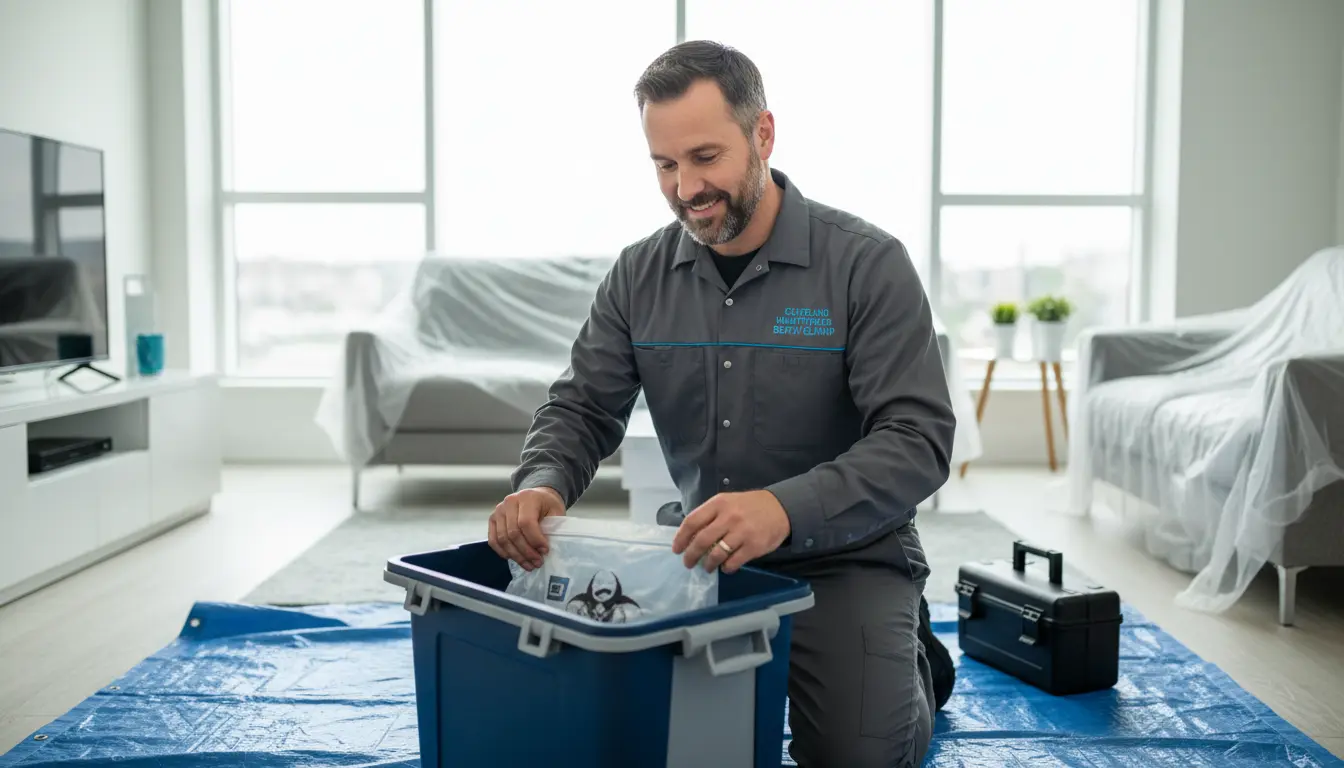
First, we conduct an initial risk assessment. Our technicians evaluate the extent of biological saturation, identify affected building materials, and check for odor migration through the HVAC system. Cleveland’s humid summers mean that decomposition fluids can wick into drywall and wood within hours, so this assessment must be thorough. We then establish containment zones using negative air machines and heavy-duty plastic sheeting to prevent airborne pathogens from spreading to unaffected areas.
Next, we initiate full personal protective equipment (PPE) protocol—Tyvek suits, respirators, face shields, and boot covers—to protect our team from bloodborne pathogens like hepatitis B, hepatitis C, and HIV. All contaminated materials, including carpet, padding, drywall, and insulation, are removed and double-bagged in biohazard waste bags for incineration. For non-porous surfaces, we use EPA-registered hospital-grade disinfectants with a dwell time verified by ATP fluorescence testing. This testing measures adenosine triphosphate, a molecule present in all biological matter, to confirm that no organic residue remains.
Local variables play a major role in our approach. Cleveland’s freeze-thaw cycles in winter can cause moisture trapped in subfloors to expand, leading to hidden biological seepage. We use specialized thermal imaging and moisture meters to detect these pockets. In summer, high humidity can reactivate odors even after cleaning, so we deploy industrial-grade ozone generators or hydroxyl machines to neutralize volatile organic compounds at the molecular level. This step is crucial for decomposition odor removal.
Finally, we apply structural encapsulation: sealing treated surfaces with antimicrobial coatings to prevent future microbial growth. We also clean and deodorize the entire HVAC system to ensure no residual contaminants recirculate. Only after passing a final ATP test and odor verification do we consider the site restored.
Professional Remediation vs. Standard Janitorial Cleaning: A Data Comparison
| Feature / Metric | Professional Biohazard Remediation | Standard Residential Cleaning |
|---|---|---|
| Regulatory Compliance | Follows OSHA 29 CFR 1910.1030, EPA waste disposal, IICRC S540 | None – no biohazard training |
| Pathogen Elimination | EPA-registered hospital-grade disinfectants, ATP testing verification | Household bleach or general cleaners – insufficient kill |
| Structural Assessment | Moisture mapping, thermal imaging, subfloor inspection | Visual surface check only |
| Odor Removal | Negative air scrubbers, ozone/hydroxyl machines, HVAC deodorization | Air fresheners or open windows – temporary masking |
| Biohazard Waste Disposal | Double-bagged, incinerated per EPA/state guidelines | Regular trash – illegal and dangerous |
| Insurance Documentation | Detailed reports for claims, compliant with adjuster requirements | None |
Expert Insights: What Only Professionals Know
Years of field experience in Cleveland have taught our team critical diagnostic tips that save homes from irreversible damage. Here are three advanced insights that separate true remediation from superficial cleaning.
1. Hidden biological seepage is the norm, not the exception. When a body decomposes, fluids don’t just pool on the surface. They migrate downward through floor joints, around baseboards, and into the subfloor. In older Cleveland homes with original hardwood and plaster, these fluids can travel laterally under the flooring, saturating the crawlspace. Standard cleaning leaves this untouched, leading to persistent odor and mold growth. Our team uses borescopes and moisture meters to find and treat every saturated area.
2. Porous materials must be replaced, not cleaned. Many property owners believe that scrubbing a bloodstained carpet or a fluid-soaked drywall patch will suffice. In reality, porous materials absorb pathogens and organic matter that cannot be fully removed by any cleaning agent. IICRC S540 standards mandate removal and replacement of any porous material that has been contaminated. Attempting to clean them only creates a false sense of safety and leaves behind bacteria that can become active again in humid conditions.
3. Negative pressure is essential to prevent cross-contamination. Without a negative air machine, airborne pathogens from the cleanup area can travel through doorways and HVAC vents into the rest of the house. During remediation, we create a pressure differential that pulls air into the containment zone and filters it through HEPA filters. This is especially important in Cleveland’s tightly sealed winter homes where natural ventilation is minimal.
Common mistakes property owners make include using household bleach on biological matter. Bleach is not effective on porous surfaces and can actually fix proteins to the material, making them harder to remove. Another mistake is waiting for the odor to dissipate naturally. Decomposition odors are caused by volatile organic compounds that will linger for months without professional intervention. Finally, allowing untrained family members or friends to enter the site before remediation exposes them to serious health risks, including respiratory infections and bloodborne diseases. The consequences are long-term health issues and structural damage that can lower property value significantly.
Pricing: What to Expect
The cost of unattended death cleanup in Cleveland varies based on several factors, but you can expect transparent, itemized estimates from a professional company. Here’s a breakdown of typical pricing structures:
- Standard site mobilization fee: $350–$750, covering the dispatch of a fully equipped crew, PPE, initial assessment, and containment setup.
- Hourly remediation rates: $150–$300 per hour per technician, depending on the complexity of the scene and the number of team members required.
- Biohazard waste disposal: $200–$500 for regulated medical waste bags, including transport and incineration fees.
- Structural material replacement: Drywall, insulation, flooring, and subfloor removal and replacement are charged per square foot, typically $50–$150 per square foot depending on materials and labor.
- HVAC decontamination: $500–$1,500 for cleaning ducts, coils, and installing filtration systems.
- Odor removal services: Ozone or hydroxyl treatment costs $300–$800 per room.
- Insurance claim support: No additional charge – our team works directly with your adjuster to document the process.
Three key factors influence the total cost: the volume of biohazardous waste, the extent of porous material replacement needed, and whether the HVAC system requires decontamination. Cleveland homes with forced-air heating are particularly vulnerable to odor spread, so we always recommend a full assessment.
Safety & Standards: Certifications That Matter
Our commitment to safety is backed by rigorous certifications and compliance with national standards. Every technician at Cleveland Unattended death cleanup holds current IICRC Trauma and Crime Scene Cleanup certification (IICRC S540). We also adhere to OSHA Bloodborne Pathogens Standard 29 CFR 1910.1030, which mandates proper PPE use, exposure control plans, and regulated waste disposal. Additionally, we follow EPA guidelines for the use of disinfectants and the disposal of biohazardous materials.
These standards are not just paperwork; they have real-world implications. For example, if a homeowner attempts to clean a scene using household products, they risk exposure to hepatitis B, which can survive on surfaces for up to seven days. Professional remediation ensures that every pathogen is eliminated, and that waste is disposed of in licensed incinerators. In Cleveland, where multi-unit dwellings are common, failure to properly contain and clean a scene can lead to neighbor complaints, health department fines, and liability lawsuits.
Frequently Asked Questions
How long does unattended death cleanup typically take?
The duration depends on the severity of the scene and the size of the affected area. For a single room with moderate decomposition, our team usually completes the job within one to two days. However, if fluids have penetrated the subfloor, HVAC system, or multiple rooms, the process can extend to three to five days. We always provide a timeline estimate after the initial assessment.
Is it safe to stay in the home during cleanup?
No, it is not safe. The containment area creates a hazard zone with airborne pathogens and chemical disinfectants. We require that all occupants vacate the premises during active remediation. Once we complete ATP testing and odor verification, we will give you the all-clear. Typically, you can return the same day for minor scenes, but for larger projects, we recommend overnight absence.
Will my homeowners insurance cover unattended death cleanup?
Many standard homeowners insurance policies cover biohazard remediation as part of their damage and liability provisions. However, coverage varies, and some policies may exclude unattended death unless you have a specific rider. Our team provides detailed documentation and works directly with your insurance adjuster to facilitate the claim. We recommend contacting your provider as soon as possible after the discovery.
What happens to the personal belongings in the room?
We handle personal belongings with the utmost respect. Non-porous items like metal furniture and electronics can often be cleaned and disinfected. Porous items such as clothing, bedding, and upholstered furniture that have been contaminated must be disposed of as biohazard waste. We photograph and catalog all items for insurance purposes. If you wish to keep any uncontaminated items, we can relocate them to a safe area before cleanup begins.
Do you offer emergency response services?
Yes, we provide 24/7 emergency response for unattended death scenes in Cleveland. Time is critical—biological fluids begin breaking down immediately, and prompt remediation reduces structural damage and odor penetration. Our team can be on-site within two hours of your call, even in winter conditions when road access may be challenging.
Professional Biohazard Remediation in Cleveland
When you’re facing the aftermath of an unattended death, the priority is safety, dignity, and restoring your property to a livable state. Our team at Cleveland Unattended death cleanup combines technical expertise with compassionate service. We know that this is a difficult time, and we handle every scene with the respect it deserves. From the initial assessment to final ATP verification, we follow a proven process that eliminates biohazards, neutralizes odors, and protects your home from long-term damage. Whether you need blood spill remediation, structural damage repair, or insurance claim support, we are the trusted provider in Cleveland. Contact us today for a confidential consultation and let us help you move forward.