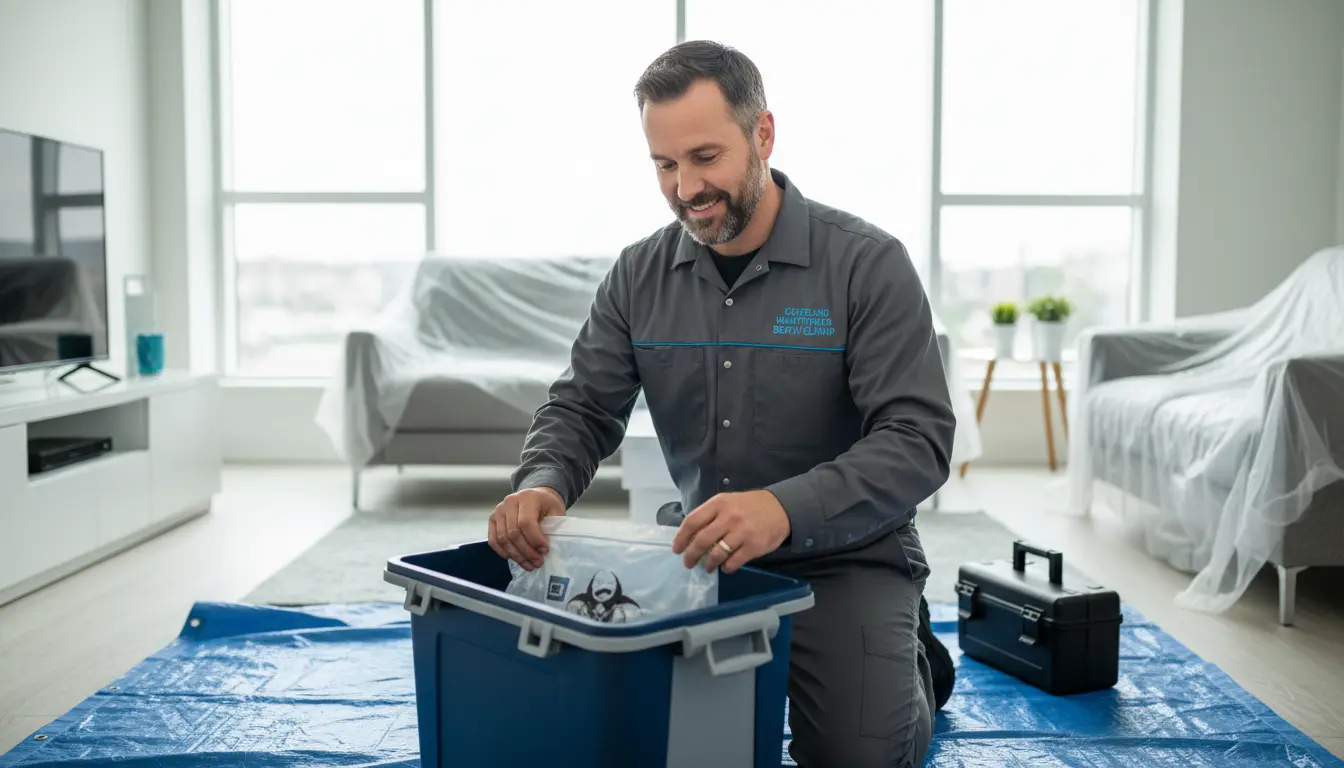
The first sign was a faint, sweet odor seeping from the second-floor apartment on West 25th Street. By the time the property manager called us, the smell had been present for nearly a week. The tenant hadn’t answered calls or texts, and the mail was piling up. When the police finally forced the door, they found the man had passed away sometime during the previous weekend. The body had lain there for days, and the scene was no longer something a mop and bleach could handle.
That call is one of hundreds we take every year in Cleveland, Ohio. Unattended death cleanup is not a simple cleaning job—it’s a specialized form of biohazard remediation that requires technical training, regulatory compliance, and a deep understanding of decomposition science. Whether the death occurred in a historic home in Slavic Village, a modern condo in Little Italy, or a rental property in Garfield Heights, the process follows a strict, science-backed protocol. In this article, we’ll walk through exactly how unattended death cleanup works in Cleveland, OH, from the initial assessment to the final clearance tests, and explain why professional remediation is the only safe option.
Why Unattended Death Cleanup Requires Professional Biohazard Remediation
When a death goes undiscovered for hours or days, the body begins to decompose. This process releases a cascade of biological fluids, airborne pathogens, and volatile organic compounds that can penetrate walls, flooring, and HVAC systems. The longer the body remains, the more extensive the contamination. Standard household cleaning products—even bleach—are not designed to eliminate bloodborne pathogens or prions that may be present. In fact, using bleach on biological matter can create harmful fumes and fail to deactivate certain viruses.
Beyond the immediate health risks, there is also the issue of structural damage. The fluids released during decomposition can seep into hardwood floors, drywall, and subflooring, causing permanent staining, odor absorption, and even microbial growth. If not properly remediated, the property can become a health hazard for future occupants and may lose significant market value. Professional biohazard remediation companies in Cleveland follow the IICRC S540 Standard for Trauma and Crime Scene Cleanup, which mandates specific cleaning, disinfection, and verification protocols. This ensures that the site is not only visually clean but also biologically safe.
Step-by-Step Process: How Unattended Death Cleanup Works in Cleveland, OH
Initial Risk Assessment and Site Security
The first step always involves a thorough risk assessment. Our technicians arrive in full personal protective equipment (PPE)—Tyvek suits, N95 or P100 respirators, nitrile gloves, and eye protection. We evaluate the scope of the contamination, identify potential hazards such as sharps, medicinal waste, or structural instability, and secure the area to prevent cross-contamination. This is especially critical in Cleveland’s older homes, where porous materials like lath-and-plaster walls or historic wood flooring can trap biological residues.
Removal of Biological Materials and Contaminated Items
Using specialized forensic cleaning tools, we remove all visible biological matter, including blood, tissue, and bodily fluids. Any porous materials that have been soaked—carpet, padding, drywall, insulation—are cut out and bagged in biohazard containers. This step is not about cleaning; it’s about physically removing the source of contamination. The waste is then transported to licensed medical waste incinerators in compliance with Ohio EPA regulations.
Chemical Disinfection and ATP Testing
After the gross removal, we apply EPA-registered hospital-grade disinfectants across every surface, including walls, ceilings, and subflooring. We use enzyme-based cleaners to break down proteins in blood and tissue, then follow with a broad-spectrum disinfectant proven to kill hepatitis B, HIV, and other bloodborne pathogens. To verify efficacy, we perform adenosine triphosphate (ATP) testing—a swab test that measures organic residue levels. A reading below a certain threshold indicates that the surface is biologically clean. This is a non-negotiable step in the step-by-step unattended death cleanup process.
Odor Neutralization and Structural Decontamination
Decomposition odors are caused by volatile organic compounds (VOCs) that linger in the air and porous materials. We deploy industrial-grade negative air machines with HEPA filtration to capture airborne particulates, and ozone generators or hydroxyl generators to oxidize lingering odors. In cases where the death has been undiscovered for a week or more, we may need to treat the entire HVAC system to prevent cross-contamination. This is where the shocking facts about decomposition and biohazards become clear: even after visible cleanup, the air can still be hazardous.
Professional Remediation vs. Standard Cleaning: A Data Comparison
To understand the difference between professional biohazard remediation and a standard janitorial clean, consider the following metrics:
| Feature / Metric | Professional Biohazard Remediation | Standard Residential Cleaning |
|---|---|---|
| Regulatory Compliance | OSHA 29 CFR 1910.1030, IICRC S540, Ohio EPA medical waste disposal | None (assumes household cleaning standards) |
| Pathogen Elimination | EPA-registered disinfectants + ATP testing to verify 99.99% reduction | Bleach or household cleaners (may not kill all bloodborne pathogens) |
| Structural Assessment | Inspection of subflooring, drywall, and HVAC for hidden contamination | Not performed |
| Odor Control | Negative air, ozone, hydroxyl generators, enzymatic cleaners | Air fresheners or candles (masking only) |
| Waste Disposal | Licensed medical waste transport and incineration | Regular trash (illegal for biohazard) |
Expert Insights: Advanced Diagnostic Tips for Property Owners
Even after professional cleanup, hidden contamination can remain. Here are three advanced diagnostic tips that our technicians use:
1. Thermal Imaging for Hidden Biological Seepage
Biological fluids can wick up drywall or seep beneath flooring long after the visible stain is removed. By using thermal imaging cameras, we can detect temperature differences caused by moisture behind walls. This allows us to target areas that need cutting out, preventing future microbial growth and odor recurrence.
2. Porous Material Replacement Is Not Optional
Many property owners try to save money by cleaning porous materials like carpet padding or mattresses. In reality, these materials cannot be fully disinfected because blood and bodily fluids soak into the fibers and foam. The IICRC S540 standard explicitly states that porous materials contaminated with blood or other potentially infectious materials must be removed and replaced. Attempting to clean them is a common mistake that leads to long-term health risks.
3. Negative Pressure Containment Is Critical
If the cleanup area is not isolated with negative air pressure, airborne pathogens can travel to other parts of the building. This is especially important in multi-unit dwellings common in neighborhoods like Detroit Shoreway or Hough. We use HEPA-filtered negative air machines to create a vacuum that pulls air from the contaminated room through the filter, preventing cross-contamination.
Common Mistakes Property Owners Make
One of the most frequent errors is using household bleach on biological matter. Bleach is corrosive, can damage surfaces, and does not effectively deactivate prions or certain viruses. Another mistake is waiting for the odor to dissipate naturally. Decomposition odors are caused by VOCs that can remain in porous materials for months, leading to tenant complaints or health issues. Finally, allowing untrained personnel—even well-meaning family members—into the site without proper PPE exposes them to hepatitis B, HIV, and other bloodborne pathogens. The consequences can include lifelong health problems and legal liability for the property owner.
Pricing: What to Expect for Unattended Death Cleanup in Cleveland
Costs vary based on several factors, but here are typical pricing structures:
- Site mobilization fee: $200–$500 to cover arrival, PPE, and equipment setup.
- Hourly remediation rate: $150–$300 per hour per technician, depending on the complexity and number of technicians needed.
- Biohazard waste disposal: $100–$500 per container, based on volume and weight.
- Structural material replacement: $500–$5,000+ if drywall, flooring, or subflooring must be removed and replaced.
Three major factors influence the final cost: the extent of structural material replacement required (e.g., if the body has been undiscovered for weeks, fluids may have soaked deep into subflooring), the total volume of biohazardous waste (which directly affects disposal fees), and the necessity for specialized HVAC decontamination (common in homes with central air systems in areas like Bay Village or Brooklyn). For a detailed breakdown, see our ultimate guide to biohazard cleanup after death.
Safety and Standards: Certifications That Matter
Professional biohazard remediation companies must comply with OSHA Bloodborne Pathogens Standard 29 CFR 1910.1030, which mandates that all employees have bloodborne pathogen training, a written exposure control plan, and use appropriate PPE. Additionally, the IICRC S540 standard governs training and certification for trauma and crime scene cleanup. In Ohio, medical waste disposal is regulated by the Ohio EPA, requiring that all biohazardous waste be transported by licensed carriers and incinerated at approved facilities. These standards exist to protect not only the workers but also the property owner, future occupants, and the community. Cutting corners on safety can lead to fines, lawsuits, and prolonged health risks.
Frequently Asked Questions About Unattended Death Cleanup
How long does the cleanup process take?
Duration depends on the extent of contamination. A standard room cleanup may take 4–8 hours, while a large home or a death that was undiscovered for weeks can require multiple days. The what to do after discovering an unattended death guide outlines the immediate steps to take, including contacting professionals within 24 hours to prevent further spread.
Is it safe to use bleach on blood stains?
No. Bleach is not effective against all bloodborne pathogens and can actually create toxic fumes when mixed with organic matter. Professional cleanup uses EPA-registered disinfectants that are specifically formulated to kill hepatitis B, HIV, and other pathogens. Moreover, bleach does not break down proteins, which can leave behind biological residues that attract pests.
Will insurance cover the cost of cleanup?
Many homeowner’s insurance policies cover unattended death cleanup under the “accidental damage” or “biohazard removal” clauses. However, it depends on the specific policy. It is always recommended to contact your insurer immediately after a death is discovered. Our team works directly with insurance adjusters to provide detailed itemized estimates and documentation.
What happens if the cleanup is not done correctly?
Improper cleanup can lead to lingering odors, microbial growth, and health risks for future occupants. In some cases, property values may drop significantly, and the property may be deemed uninhabitable. Additionally, improper disposal of biohazard waste is a violation of Ohio EPA regulations and can result in fines. This is why the why Cleveland trusts experts for death scene cleanup is rooted in safety and compliance.
Do I need to leave the property during cleanup?
Yes. For your safety, we recommend that all occupants vacate the area during the remediation process. We use negative air pressure and chemical fogging that can be harmful to inhale. Once the final ATP test passes and the odor is neutralized, the property is safe to re-enter, typically within 24–48 hours.
Professional Biohazard Remediation in Cleveland
Unattended death cleanup is a technically demanding, emotionally sensitive process that requires expertise, compassion, and strict adherence to safety standards. Whether you are a property manager, landlord, or family member, the right approach is to call a certified biohazard remediation company immediately. The team at Cleveland Unattended Death Cleanup has years of experience handling these scenarios across Cuyahoga County, from the historic row houses of Ohio City to the mid-century homes of Maple Heights and Bedford. We understand the local climate challenges—the Great Lakes humidity that accelerates decomposition, the winter ice that complicates site access—and we have the equipment and training to handle them. If you are facing an unattended death, do not wait. Contact us for a discreet, professional, and thorough remediation that restores safety and peace of mind.