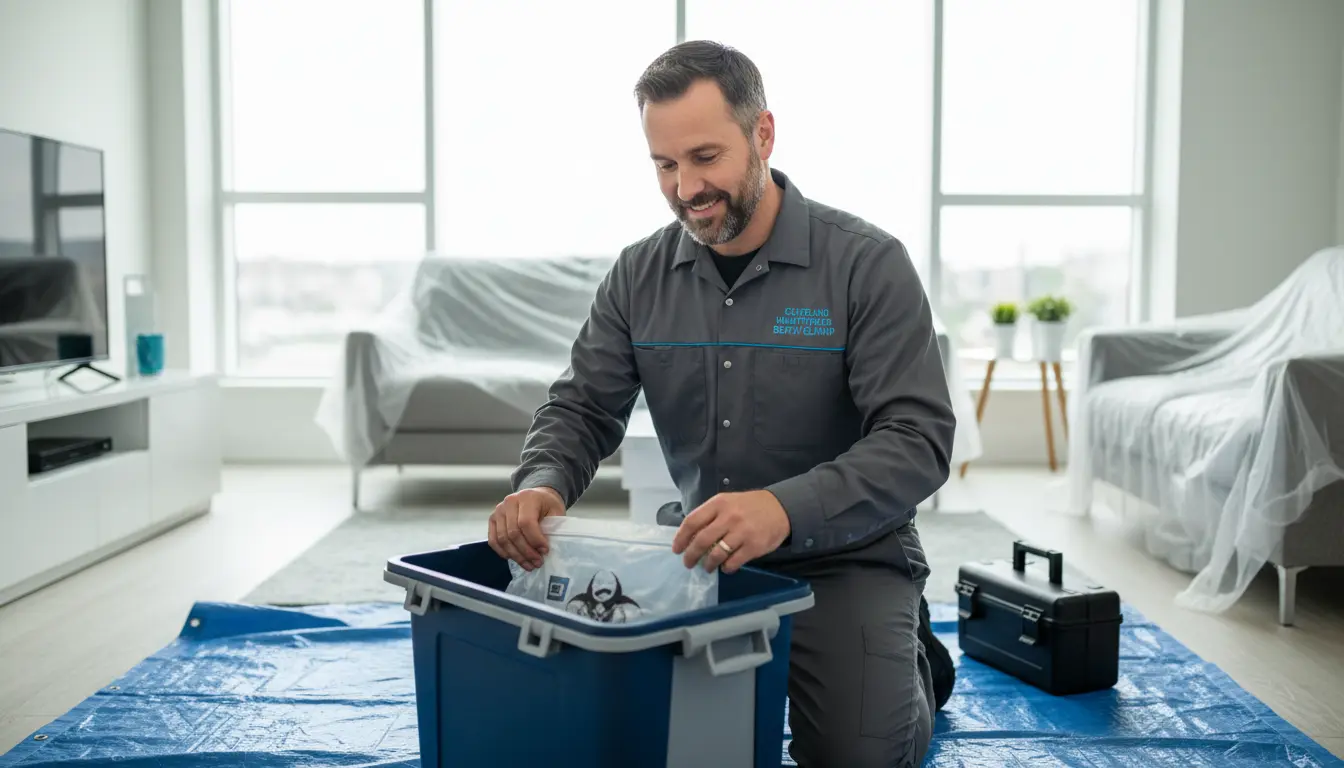
The common belief that unattended death cleanup should begin the moment a body is discovered sounds logical, but in practice, it can be dangerously premature. In Cleveland, where the Great Lakes generate a persistent humidity that accelerates biological decomposition, rushing into a scene without proper assessment often leads to cross-contamination, missed biohazards, and unnecessary health risks for everyone involved. The real question is not just how quickly cleanup should start, but what must happen before a single piece of equipment is brought in.
When a death goes undiscovered for days or weeks, the environment becomes a complex biohazard zone. Bloodborne pathogens, bacterial aerosols, and volatile organic compounds saturate the air and porous surfaces. A professional remediation team must first secure the scene, conduct a thorough risk assessment, and establish containment protocols. For Cleveland homeowners and property managers, understanding this timeline is critical to protecting both health and property value. This article breaks down the optimal timeline, the science behind it, and why professional intervention is non-negotiable in the Cleveland area.
Why the First 24 Hours Are Critical — But Not for Cleanup
Contrary to what many property owners expect, the first 24 hours after discovery are not about scrubbing floors or discarding furniture. They are about stabilization and planning. Once a death is reported, law enforcement and the coroner’s office must complete their investigation. During this period, the scene is legally off-limits to anyone not authorized. Attempting to clean before release can interfere with evidence, delay investigations, and even expose you to legal liability.
Once the scene is released, the clock truly starts. In Cleveland’s humid climate, decomposition continues to release bioaerosols even after the body is removed. Fluids have already seeped into subflooring, drywall, and HVAC systems. Every hour of delay allows these contaminants to spread deeper into the structure. Professional biohazard remediation should ideally begin within 2 to 4 hours of scene release. This window prevents odor migration, limits structural damage, and reduces the risk of airborne pathogens affecting neighboring units in multi-family homes common in neighborhoods like Slavic Village or Detroit Shoreway.
Assessing the Scene Before Any Cleaning
A certified technician first performs a visual and instrumental assessment using adenosine triphosphate (ATP) testing to map biological contamination. This step identifies hidden saturation in baseboards, under carpet padding, and inside wall cavities. In older Cleveland homes with balloon-frame construction, fluids can travel vertically between floors, requiring sub-floor remediation that standard cleaning crews miss. Without this assessment, cleanup becomes guesswork.
The assessment also determines the level of personal protective equipment (PPE) needed. OSHA’s Bloodborne Pathogens Standard (29 CFR 1910.1030) mandates full-body coverage, HEPA-filtered respirators, and eye protection for any scene with visible blood or other potentially infectious materials. Skipping this step — or rushing into cleaning without it — exposes everyone to hepatitis B, hepatitis C, HIV, and bacterial infections like MRSA.
The Step-by-Step Professional Remediation Workflow
Professional unattended death cleanup follows a scientifically validated sequence designed to eliminate all biological hazards while restoring the structure to a safe, habitable condition. This is not a cleaning service; it is a decontamination and forensic restoration process governed by the IICRC S540 standard.
The first step is establishing containment. Industrial-grade negative air machines create a pressure differential that prevents airborne particles from escaping the work area. In Cleveland’s older homes, where window seals and ductwork are often compromised, this step is essential to protect the rest of the property. Next, all visible biohazardous material is physically removed — including blood-soaked carpet, pad, and subfloor sections. These are double-bagged in biohazard containers and transported to an authorized medical waste incinerator, following Ohio EPA regulations.
After gross removal, the team applies EPA-registered hospital-grade disinfectants and specialized enzyme treatments that break down organic residues at a molecular level. Every surface is then wiped down and tested again with ATP swabs to confirm pathogen elimination. Finally, structural encapsulation may be applied to seal porous materials that cannot be removed, preventing future odor off-gassing. In Cleveland’s humid summers, this step is particularly important to prevent microbial remediation issues later.
How Cleveland’s Climate and Architecture Affect the Timeline
The Great Lakes create a unique microclimate around Cleveland that directly impacts decomposition rates. High humidity during spring and summer accelerates bacterial growth, causing fluids to break down faster and odors to become more penetrating. In winter, cold temperatures slow decomposition but introduce another challenge: property access. Snow and ice can delay the arrival of remediation vehicles and equipment. Professional teams in the Cleveland area plan for these variables by maintaining winter-ready fleets and scheduling around weather windows.
Additionally, many homes in Cuyahoga County were built in the early 20th century with plaster and lath walls, hardwood floors, and unfinished basements. These materials are highly absorbent. Blood and other body fluids can saturate deep into plaster, requiring full wall removal rather than surface cleaning. Sub-flooring in these homes often lacks modern vapor barriers, meaning fluids can seep into the soil below the crawlspace. This is why a local team familiar with historic Midwestern residential architecture is essential — they know where to look and what to replace.
Data Comparison: Professional Remediation vs. Standard Cleaning
| Feature/Metric | Professional Biohazard Remediation | Standard Residential Cleaning |
|---|---|---|
| Regulatory Compliance | OSHA 29 CFR 1910.1030, EPA waste disposal, IICRC S540 | None |
| Pathogen Elimination | EPA-registered disinfectants, ATP testing verification | Household bleach (incomplete kill) |
| Structural Assessment | Moisture meters, thermal imaging, ATP swabs | Visual only |
| Containment | Negative air machines, HEPA filtration | None |
| Waste Disposal | Authorized medical waste incineration | Regular trash (illegal) |
Expert Insights: Advanced Diagnostic Tips for Property Owners
Many property owners assume that if the floor looks dry, it’s safe. In reality, biological fluids wick into porous materials like grout, unfinished wood, and drywall tape. A professional thermal imaging camera can detect moisture pockets that are invisible to the naked eye. In Cleveland homes with radiant heating, these pockets can remain hidden for months, slowly releasing bioaerosols that cause chronic respiratory issues for occupants.
Another common mistake is trying to save carpeting or furniture by cleaning it with household products. The IICRC S540 standard explicitly states that porous materials contaminated with blood or bodily fluids must be removed and disposed of. No amount of cleaning can restore them to a safe condition. Attempting to do so leads to cross-contamination when the next family moves in.
Finally, never use fans to dry out a scene. Fans can aerosolize pathogens, spreading hepatitis and bacteria throughout the home’s ductwork. Professional teams use negative air pressure to capture airborne particles before they circulate. In Cleveland’s older homes with shared walls, this is critical to prevent contamination in adjacent units in neighborhoods like Little Italy or Bay Village.
Pricing Factors for Unattended Death Cleanup in Cleveland
- Site mobilization fee: Most professional services charge a standard mobilization fee of $200–$500 to cover travel, initial assessment, and setup of containment equipment. For locations in Cleveland’s outer suburbs like Garfield Heights or Maple Heights, travel time may increase this fee.
- Hourly remediation rates: Typical rates range from $150 to $250 per technician per hour. Complex scenes requiring multiple technicians or extended containment can quickly add up. A typical unattended death in a single bedroom may require 8–12 hours of work.
- Specialized waste disposal: Biohazardous waste must be transported to an approved incinerator, often costing $200–$600 per drum. Larger scenes producing multiple drums increase this cost proportionally.
- Structural material replacement: If subflooring, drywall, or cabinetry must be removed and replaced, those costs are separate. In historic Cleveland homes, custom millwork or plaster repair can add $1,000–$5,000.
- HVAC decontamination: If biological particles have entered the ventilation system, a separate HVAC cleaning and disinfection is required. This can cost $500–$1,500 depending on system size.
Safety and Standards Compliance
Professional biohazard remediation in Cleveland is not optional — it is a legal and ethical obligation. The Occupational Safety and Health Administration (OSHA) requires any employer or property owner to protect workers and occupants from bloodborne pathogens under 29 CFR 1910.1030. Failure to use proper PPE, containment, and disposal methods can result in fines and liability if someone becomes ill.
The Institute of Inspection, Cleaning and Restoration Certification (IICRC) publishes the S540 standard, which is the industry benchmark for trauma and crime scene cleanup. Certified firms follow this standard to ensure pathogen elimination, structural safety, and proper documentation. For Cleveland property owners, hiring an IICRC-certified firm also provides peace of mind that the work meets insurance requirements — many policies require professional remediation to approve claims for biohazard-related damage.
Additionally, the Ohio EPA regulates the disposal of medical waste. Unattended death cleanup generates regulated medical waste, which must be transported by a licensed hauler and incinerated. Dumping biohazardous materials in regular trash is illegal and can result in criminal charges. Professional teams like those at Cleveland Unattended death cleanup maintain contracts with authorized waste management services to handle this safely.
Frequently Asked Questions
How soon should I call a professional after discovering an unattended death?
Call as soon as it is safe to do so, but understand that law enforcement and the coroner must clear the scene first. Once the scene is released, you should aim to have a professional biohazard remediation team on-site within 2 to 4 hours. In Cleveland, this urgency is heightened by humidity that accelerates odor and fluid migration. Delaying beyond 24 hours increases the risk of permanent structural damage and cross-contamination to neighboring units.
Can I clean the area myself to save money?
No. Household cleaning products cannot eliminate bloodborne pathogens like hepatitis B or C. The EPA requires specific disinfectants with a minimum contact time to kill these viruses. Additionally, improper handling of contaminated materials exposes you and your family to serious health risks. Professional remediation includes ATP testing to verify that all biological material has been removed — something no DIY method can achieve. In Cleveland, where homes often have shared ventilation systems, a DIY attempt can contaminate the entire building.
What happens if I wait too long to start cleanup?
Waiting even 24 hours after scene release can allow fluids to saturate subflooring and drywall, making remediation more invasive and expensive. Odors will also set into porous materials, requiring odor-sealing encapsulation. In extreme cases, the entire subfloor or wall may need to be replaced, costing thousands more. Furthermore, lingering bioaerosols can cause respiratory illnesses for anyone spending time in the home. In Cleveland’s humid climate, mold can begin growing on bio-contaminated surfaces within 48 hours, compounding the health risks.
Do I need to hire a local Cleveland company, or can a national chain handle it?
Local expertise matters in Cleveland. Companies familiar with the area’s specific architectural styles — such as balloon-frame construction in older neighborhoods like Hough or Detroit Shoreway — know where to look for hidden contamination. They also understand local regulations for waste disposal in Cuyahoga County and can navigate winter weather challenges that might delay a team traveling from out of town. A local professional like Cleveland Unattended death cleanup can typically respond faster and with more tailored solutions.
Will my homeowner’s insurance cover the cost of cleanup?
Many homeowner’s insurance policies include coverage for biohazard cleanup, but it depends on your specific policy and the circumstances of the death. Some policies require that the cleanup be performed by a licensed, IICRC-certified professional to qualify for reimbursement. It’s best to contact your insurance agent immediately after discovery and ask about coverage for “forensic restoration” or “biohazard remediation.” Keep all documentation from the cleanup provider, including the scope of work and ATP test results, to support your claim.