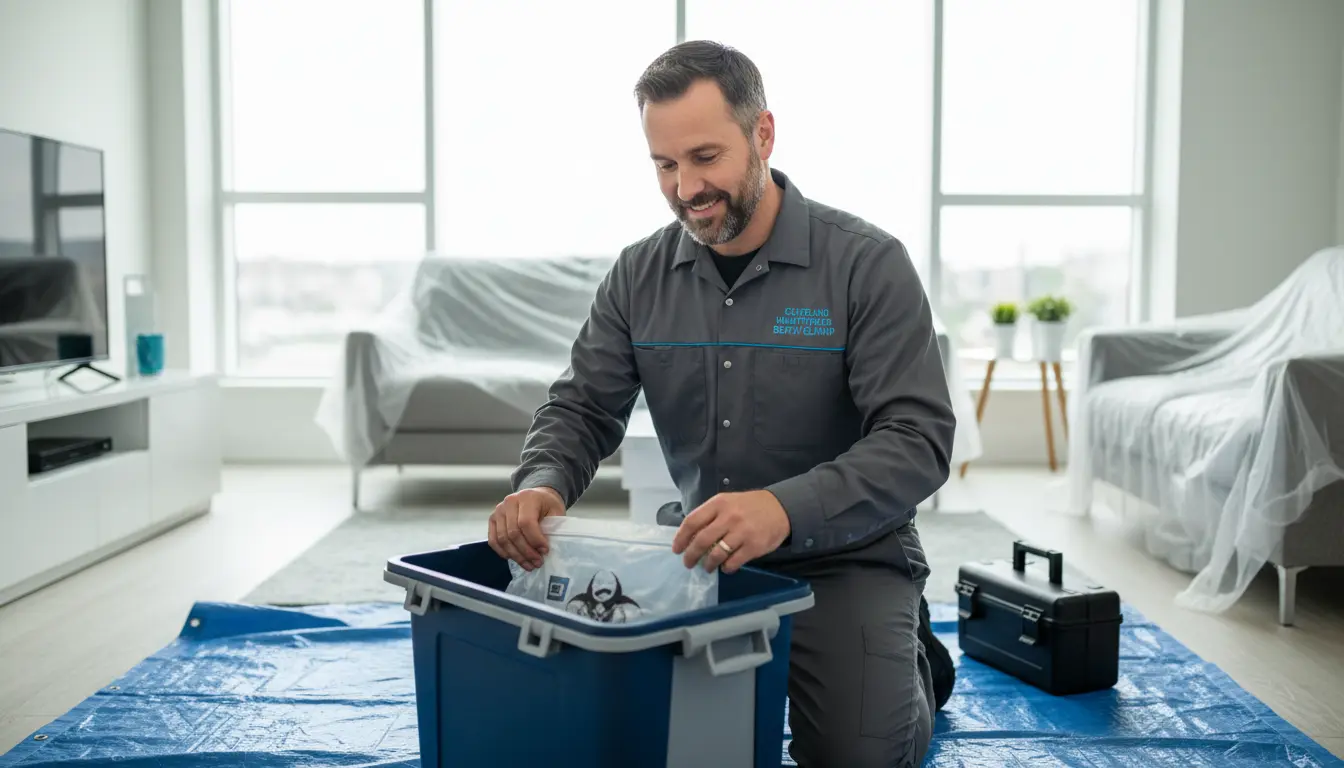
Unattended death cleanup is a specialized field of forensic restoration that operates under strict regulatory frameworks, including OSHA’s Bloodborne Pathogens Standard (29 CFR 1910.1030) and the IICRC S540 Standard for Trauma and Crime Scene Cleanup. Unlike a standard janitorial service, a certified biohazard remediation team does not simply wipe down surfaces. We assess, contain, remove, decontaminate, and verify—a multi-stage process that involves industrial-grade equipment, hospital-grade disinfectants, and a deep understanding of how decomposition fluids interact with building materials. In a city like Cleveland, where historic homes often feature plaster walls, hardwood subfloors, and unsealed crawl spaces, the technical challenges multiply. This guide walks you through each critical phase, from the initial risk assessment to the final ATP test that confirms the site is biologically safe.
Initial Risk Assessment and Scene Preparation
Before any physical work begins, the remediation team conducts a comprehensive risk assessment. This is not a cursory walkthrough. The technician evaluates the extent of biological saturation using moisture meters and thermal imaging cameras, identifying areas where fluids have wicked into porous materials like drywall, carpet padding, and wooden joists. The assessment also considers the presence of sharps, medications, or other hazardous materials that may be present. For a property in Cleveland’s Detroit Shoreway area, where older homes may have lead paint or asbestos in the walls, the assessment must also account for additional regulatory requirements from the Ohio Environmental Protection Agency.
Once the assessment is complete, the team establishes a containment zone. This is a critical step in cross-contamination prevention. Using heavy-duty polyethylene sheeting and negative air machines equipped with HEPA filtration, we create a sealed environment that prevents airborne pathogens—including bacteria, viruses, and fungal spores—from migrating into unaffected areas of the home. In a Cleveland winter, when windows are sealed and HVAC systems recirculate air, this containment is especially vital. The negative air pressure ensures that any particulate matter generated during the cleanup is captured and filtered before it can enter the rest of the structure or the neighborhood. The area is then prepared with the deployment of full personal protective equipment (PPE) for every team member, including Tyvek suits, N100 respirators, nitrile gloves, and chemical-resistant boots.
Physical Removal of Biohazardous Materials
With containment established, the physical removal phase begins. This is the most labor-intensive and technically demanding part of the step-by-step guide to restoring a property after an unattended death. All visibly affected materials must be removed. This includes saturated carpets, underlayment, drywall up to two feet above the visible stain line, baseboards, and any porous furnishings that cannot be effectively decontaminated. In the case of the Slavic Village bungalow, the hardwood flooring had to be pulled up entirely because the biological fluids had seeped through the gaps between the planks and into the subfloor below. The team uses specialized forensic cleaning tools, such as enzymatic cleaners that break down organic matter at the molecular level, to pre-treat these areas before physical removal.
During this phase, waste management is strictly controlled. All biohazardous materials are double-bagged in red biohazard bags, sealed with tamper-evident ties, and placed in rigid, leak-proof containers. These containers are then transported to an authorized medical waste incinerator, following the guidelines of the Ohio EPA and local Cuyahoga County waste disposal regulations. It is illegal to dispose of biohazardous waste through standard municipal trash services, and property owners who attempt to do so face significant fines and liability. The team maintains a detailed chain-of-custody manifest for every pound of waste removed, providing the property owner with documentation that satisfies insurance requirements and legal obligations.
Structural Decontamination and Chemical Sanitization
After the physical removal is complete, the structural decontamination process begins. This is where the science of remediation differentiates itself from simple cleaning. The entire affected area, including walls, ceilings, and subfloors, is treated with an EPA-registered hospital-grade disinfectant that has proven efficacy against a broad spectrum of pathogens, including bloodborne pathogens like Hepatitis B, Hepatitis C, and HIV. The disinfectant is applied using electrostatic sprayers, which positively charge the liquid particles so that they wrap around surfaces and penetrate into microscopic crevices. This ensures complete coverage, even on irregular surfaces like the textured plaster walls common in Cleveland’s historic Little Italy homes.
Following the initial disinfection, the team applies an enzyme treatment designed to neutralize the residual organic compounds that cause odor. Decomposition fluids contain volatile organic compounds (VOCs) that can persist in porous materials for months or even years if not properly treated. The enzyme treatment breaks down these compounds at the cellular level, eliminating the odor at its source rather than simply masking it. This is particularly important in Cleveland’s humid summer months, when the Great Lakes-effect humidity profile can reactivate dormant odor molecules, causing them to resurface even after an area appears clean. The team then uses an industrial-grade ozone generator or hydroxyl generator to further oxidize any remaining airborne contaminants. This multi-layered approach ensures that the property is not only visually clean but also biologically safe and odor-free.
Verification and Final Clearance Testing
No restoration is complete without rigorous verification. The team performs adenosine triphosphate (ATP) fluorescence testing, a method borrowed from the food safety and healthcare industries. ATP testing measures the presence of biological residue on surfaces by detecting the energy molecule common to all living cells. A sterile swab is wiped across a 10×10 centimeter area, then inserted into a luminometer, which produces a numerical reading. Acceptable levels are measured in relative light units (RLUs), and any reading above the established threshold requires re-cleaning and retesting. In the Slavic Village project, the initial ATP readings in the subfloor cavity were over 5,000 RLUs; after the full decontamination protocol, readings dropped below 30 RLUs, well within the safe range.
The final clearance also includes a visual inspection using black light (UV) illumination. Decomposition fluids fluoresce under UV light, revealing any residual staining that may have been missed during the physical removal phase. If any fluorescence is detected, the area is re-treated. Once the site passes both the ATP test and the UV inspection, the team produces a detailed clearance report that includes all test results, the chain-of-waste manifests, and a log of all cleaning agents used. This document is essential for insurance claims and for future property transactions. A property in Garfield Heights that has undergone this rigorous verification process is far more marketable than one where the cleanup was handled casually.
Data Comparison: Professional Remediation vs. Standard Cleaning
To illustrate the difference between professional biohazard remediation and a standard residential cleaning approach, consider the following comparison based on IICRC S540 standards and real-world outcomes:
| Feature/Metric | Professional Biohazard Remediation | Standard Residential Cleaning |
|---|---|---|
| Regulatory Compliance | Full adherence to OSHA 29 CFR 1910.1030, Ohio EPA waste disposal, and IICRC S540 standards | No regulatory oversight; may violate waste disposal laws |
| Pathogen Elimination | EPA-registered hospital-grade disinfectants with proven log-6 kill rates against bloodborne pathogens | Household bleach or general-purpose cleaners; ineffective against many viruses and spores |
| Structural Assessment | Moisture meters, thermal imaging, and UV inspection to detect hidden biological seepage | Visual inspection only; misses fluid migration into subfloors and wall cavities |
| Odor Elimination | Enzyme treatments and ozone/hydroxyl oxidation targeting VOCs at the molecular level | Air fresheners or open windows; temporary masking of odors |
| Waste Disposal | Biohazard bags, rigid containers, and authorized incineration with chain-of-custody documentation | Regular trash pickup; illegal and dangerous |
| Clearance Verification | ATP fluorescence testing and black light inspection with written report | None; no scientifically validated confirmation of safety |
Source: IICRC S540 Trauma and Crime Scene Cleanup Standard
Expert Insights: Advanced Diagnostic Tips for Property Owners
Understanding the technical nuances of this process can help property owners make informed decisions. First, hidden biological seepage is a primary concern in properties with porous materials. In a home in Bay Village, where the structure had original oak flooring, the visible stain was only a few feet in diameter, but moisture meters revealed that the fluid had traveled laterally under the floorboards for over 15 feet, requiring the replacement of a much larger section. Second, porous materials such as drywall, carpet padding, and unsealed concrete nearly always require replacement rather than cleaning. The microscopic pores trap biological material that cannot be fully removed by any chemical or mechanical means. Attempting to clean these materials leaves behind a reservoir of pathogens that can become active again with moisture or temperature changes. Third, the use of negative pressure is not optional. Without it, the air movement created by cleaning activities can spread bioaerosols throughout the entire home, contaminating HVAC systems and ductwork. A home in Hough that was initially cleaned by a general contractor without containment required a second, far more expensive full-HVAC decontamination.
Pricing Factors for Unattended Death Cleanup
Pricing for professional biohazard remediation varies based on several key factors. While a general estimate can be provided, each site is unique. The following bullet points outline the primary cost drivers:
- Site mobilization and assessment fees: Most professional companies charge a mobilization fee that covers the deployment of the team, the setup of containment equipment, and the initial risk assessment. In Cleveland, this fee typically ranges from $350 to $750, depending on the distance traveled and the complexity of the site access. Winter conditions, such as ice management for driveways and walkways in areas like Brooklyn, can add a surcharge for safe equipment transport.
- Hourly remediation rates: The labor-intensive nature of biohazard removal means that the bulk of the cost is hourly. Rates for a certified team of two to three technicians generally range from $150 to $300 per hour. For a typical unattended death in a single-family home that has been undiscovered for two to four weeks, the total hours can range from 10 to 30 hours, depending on the square footage and the degree of saturation.
- Itemized costs for specialized disposal: Biohazardous waste disposal is charged by weight. Medical waste incineration fees in Cuyahoga County are approximately $1.50 to $3.00 per pound. A moderate scene may generate 50 to 150 pounds of waste, adding $75 to $450 to the total cost. Additionally, if structural materials such as subflooring or drywall need to be replaced, the cost of new materials and the labor for installation are billed separately, often based on contractor repair rates.
The extent of structural material replacement required is often the largest variable. A home in Slavic Village with saturated hardwood flooring and subflooring may require $2,000 to $5,000 in carpentry repairs alone. The total volume of biohazardous waste also drives cost, as does the necessity for specialized HVAC decontamination if the system was running during the decomposition period. In a property in Little Italy where the HVAC unit was located in the same room as the deceased, the entire duct system had to be sealed and treated, adding over $1,200 to the project. For property owners, obtaining a detailed written estimate that breaks down each of these components is essential for insurance reimbursement.
Safety and Industry Standards
The safety protocols governing unattended death cleanup are not optional guidelines; they are enforceable standards designed to protect workers, property owners, and the public. OSHA’s Bloodborne Pathogens Standard (29 CFR 1910.1030) requires that all employees with occupational exposure to blood or other potentially infectious materials receive training, be offered the Hepatitis B vaccine, and use appropriate PPE. Every technician on a Cleveland Unattended death cleanup crew carries proof of this training and works under a written exposure control plan. The IICRC S540 Standard further specifies the procedures for trauma and crime scene cleanup, including the disinfection verification protocols and waste handling requirements.
In Ohio, the Ohio EPA regulates the disposal of biomedical waste under Ohio Administrative Code 3745-27. All infectious waste must be incinerated at a permitted facility, and the transporter must hold a valid license. Using an unauthorized waste hauler can result in fines of up to $10,000 per violation for the property owner. For a home in Garfield Heights, we coordinated directly with a licensed medical waste transporter to ensure the entire waste stream was tracked from the property to the incinerator. This documentation is also critical for the property’s insurance claim, as most policies require proof of proper disposal before reimbursing for cleanup costs. The practical importance of these standards cannot be overstated: they prevent the spread of communicable diseases such as Hepatitis C, which can survive on surfaces for up to three weeks, and MRSA, which can persist for months.
Frequently Asked Questions
How long does the unattended death cleanup process typically take?
The duration depends on several factors, including the size of the affected area, the degree of decomposition, and the types of building materials involved. For a standard single-family home in Cleveland where the death was discovered within one to two weeks, the remediation process usually takes one to three days. This includes the initial assessment, physical removal, decontamination, and verification. However, if the decomposition has progressed to a stage where fluids have migrated into wall cavities, subflooring, or HVAC systems, the timeline can extend to five days or more. For example, a project in the Detroit Shoreway neighborhood required three full days of structural drying after the removal phase because the subfloor had absorbed a significant volume of fluid, and we needed to ensure the wood was dry enough for effective decontamination.
Is it safe for me to stay in the home during the cleanup?
No, it is not safe for property owners or occupants to remain on-site during the active remediation phase. The use of negative air machines creates a pressure differential that can cause doors to seal shut, and the chemical disinfectants and ozone treatments used require the area to be vacated for health reasons. Additionally, the emotional impact of witnessing the removal process can be severe. Professional remediation companies, including our team, recommend that property owners make arrangements to stay elsewhere for the duration of the project, which typically lasts one to three days. Once the clearance testing is complete and the site has been re-ventilated, it is safe to re-enter. We always provide a written clearance report that confirms the site meets all safety standards before allowing reoccupation.
Will my homeowners insurance cover the cost of unattended death cleanup?
Most standard homeowners insurance policies in Ohio cover biohazard cleanup as part of their dwelling protection or personal property coverage, provided the death was accidental or unattended. However, coverage varies widely by carrier and policy. It is essential to contact your insurance agent immediately after the discovery and before any cleanup work begins. We work directly with insurance companies to provide detailed estimates, chain-of-waste manifests, and clearance reports that facilitate claim approval. For property owners in Cuyahoga County, we have seen coverage ranges from $5,000 to $25,000 for biohazard remediation. In some cases, if the policy excludes death cleanup specifically, the cost may fall under the policy’s “pollutant cleanup” clause. Our team can help you navigate this process and provide the documentation your adjuster requires.
What happens if I try to clean the site myself?
Attempting to clean an unattended death scene without proper training, equipment, and disposal methods poses serious health, legal, and financial risks. Without a negative air machine and HEPA filtration, you risk inhaling bioaerosols that can contain Hepatitis B, Hepatitis C, HIV, and a range of bacterial pathogens. Using household bleach—as many people do—actually fails to kill these pathogens in the presence of organic matter. Furthermore, improper disposal of biohazardous waste in regular trash is illegal under Ohio law and can result in fines. Financially, an incomplete cleanup that leaves behind biological residue can lead to future mold growth, persistent odors, and structural decay, all of which reduce property value and may void insurance coverage. We have seen cases in Slavic Village where a DIY attempt cost the property owner an additional $8,000 in professional remediation because the initial effort spread contamination rather than containing it.
How do you handle odor removal that has penetrated walls or HVAC systems?
Odor removal requires a multi-modal approach. First, we identify the source of the odor using thermal imaging and moisture meters to locate hidden biological reservoirs. After physical removal and chemical decontamination, we apply an enzyme-based odor counteractant that targets the VOCs responsible for the smell. In cases where the odor has entered the HVAC system, we seal and treat the ductwork using a fogger that dispenses a hospital-grade deodorizer. We then use a hydroxyl generator, which produces safe, reactive molecules that oxidize airborne odor particles without leaving residue. For severe cases, such as a property in Hough where decomposition had occurred over four weeks, we used an ozone generator for a 24-hour shock treatment, followed by a thorough ventilation period. All odor treatments are followed by a sensory verification test—our lead technician walks the property with a clean, trained sense of smell to confirm that no trace of decomposition odor remains.
Biohazard Remediation Services in Cleveland
Restoring a property after an unattended death is a complex, scientifically rigorous process that demands technical expertise, regulatory compliance, and profound sensitivity. For homeowners and property managers in Cleveland—from the historic rowhouses of Little Italy to the suburban residences of Bay Village—the decision to engage a certified biohazard remediation team is the only safe and legal path forward. Our technicians are trained to the IICRC S540 standard and equipped with the tools necessary to handle the unique challenges posed by the region’s climate and building stock. We understand that this is not just a job; it is a restoration of safety, value, and peace of mind. Contact Cleveland Unattended death cleanup for a discreet, professional assessment. We are available 24/7 to respond to scenes throughout Cuyahoga County, providing the thorough, compassionate, and technically rigorous service your property deserves.