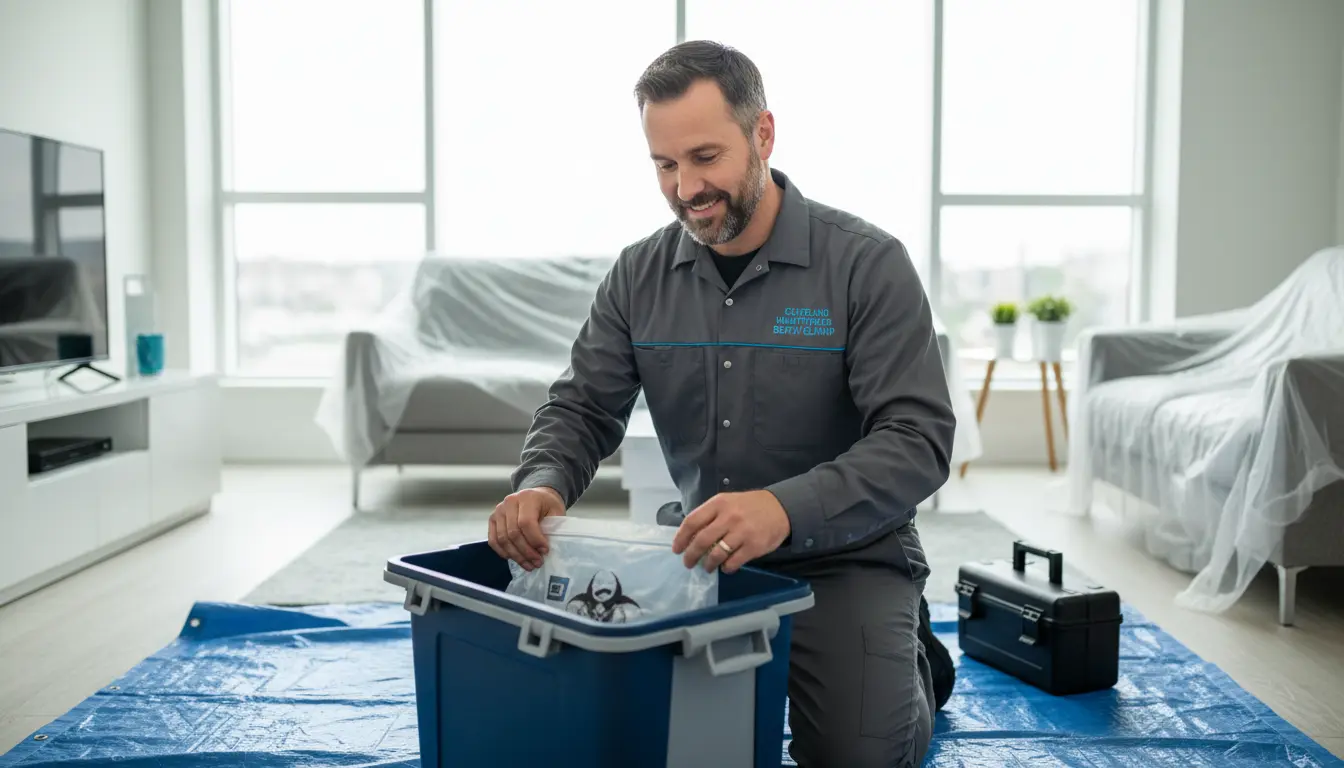
That assumption is more common than most property owners realize. When a tenant dies alone and remains undiscovered for days or weeks, the scene is not a simple cleaning job. It is a complex biohazard remediation project involving bloodborne pathogens, structural saturation, and regulatory compliance. For landlords in Cleveland, understanding what unattended death cleanup for landlords: What property owners should know entails is not just about liability—it is about protecting the long-term value of the property and the health of future occupants.
Professional biohazard remediation is critical in Cleveland to ensure safety and property value retention. The unique climate conditions, aging housing stock, and local regulations make it essential to work with a certified team. Cleveland Unattended death cleanup provides the premier, authoritative, and discreet service that property owners in this region need.
The Technical Process of Unattended Death Cleanup
Professional remediation follows a strict, science-based workflow that begins long before any cleaning solution touches a surface. The first step is a comprehensive risk assessment. Technicians arrive in full personal protective equipment (PPE) and use industrial-grade meters to measure airborne pathogens and volatile organic compounds. This initial evaluation determines the scope of contamination and the specific protocols required.
Next, the team establishes containment. High-efficiency particulate air (HEPA) negative air machines are placed at all entry points to create a pressure differential. This prevents airborne contaminants from migrating to unaffected areas of the property. In Cleveland’s older homes with shared ductwork, this step is especially critical to avoid cross-contamination between units.
The physical removal of biohazardous materials follows. Technicians use specialized enzyme treatments to break down biological matter at the molecular level, followed by hospital-grade disinfectants that meet EPA standards for viral and bacterial inactivation. Every surface—walls, subfloors, baseboards, and ceiling tiles—is treated. After the initial cleaning, adenosine triphosphate (ATP) fluorescence testing verifies that all organic material has been eliminated. The final step involves structural encapsulation, where porous materials like drywall and carpet that cannot be fully decontaminated are removed and replaced according to IICRC S540 standards.
Cleveland’s Great Lakes-effect humidity plays a major role in decomposition rates. A body discovered in a humid August apartment will decompose far faster than one found in a dry, heated unit in January. This means the window for odor migration and structural saturation is much smaller in summer months. Professional teams adjust their protocols based on these local variables, using advanced moisture meters to detect hidden biological seepage behind walls and under flooring.
Professional Remediation vs. Standard Janitorial Cleaning
A common misconception among landlords is that a thorough cleaning crew can handle the aftermath of an unattended death. The reality is that standard janitorial services lack the training, equipment, and legal authorization to deal with biohazardous waste. The difference is not subtle—it is a matter of public health and legal compliance.
| Feature/Metric | Professional Biohazard Remediation | Standard Residential Cleaning |
|---|---|---|
| Regulatory Compliance | OSHA 29 CFR 1910.1030, EPA, IICRC S540 | None |
| Pathogen Elimination | EPA-registered disinfectants + ATP testing | Household bleach (ineffective on bloodborne pathogens) |
| Structural Assessment | Moisture meters, thermal imaging, hidden seepage detection | Visual only |
Source: IICRC S540 Trauma and Crime Scene Cleanup Standard
Standard cleaning crews are not equipped to handle the risks involved. They lack the necessary PPE, the knowledge of proper disposal protocols for biohazardous waste, and the insurance coverage required for this type of work. A landlord who hires a general cleaning service after an unattended death is exposing themselves to significant liability.
Expert Insights for Property Owners
Advanced Diagnostic Tips
One of the most overlooked aspects of unattended death cleanup is hidden biological seepage. Fluids from decomposition can travel through floor joists, along plumbing chases, and into neighboring units. A professional technician uses thermal imaging cameras and moisture meters to detect these hidden pockets of contamination. If left untreated, they become breeding grounds for mold and bacteria that can affect the entire building.
Another critical diagnostic tip is understanding that porous materials must almost always be replaced, not cleaned. Drywall, carpet padding, and untreated wood absorb biological fluids at a cellular level. Even after a thorough cleaning, these materials can retain pathogens and odors. The only safe approach is removal and replacement according to structural decontamination standards.
Negative pressure is not optional—it is mandatory. Without a properly sealed containment zone, airborne particles from the remediation site can travel through the HVAC system and contaminate adjacent units. In multi-family properties common in neighborhoods like Hough and Garfield Heights, this can create a cascade of health and liability issues.
Common Mistakes Landlords Make
The most frequent error is using household bleach on biological matter. Bleach is not a registered disinfectant for bloodborne pathogens. It can actually fix organic material to surfaces, making it harder to remove and increasing the risk of long-term odor and bacterial growth. Many landlords who attempt to clean the scene themselves end up calling a professional weeks later when the smell returns.
Waiting for odor to dissipate naturally is another costly mistake. Decomposition odors are caused by volatile organic compounds that bond with porous materials. They do not go away on their own. The longer the delay, the deeper the contamination penetrates into the structure, increasing the cost of remediation exponentially.
Allowing untrained personnel—including maintenance staff or family members—into the site before professional remediation is a serious safety violation. Exposure to bloodborne pathogens like hepatitis B, hepatitis C, and HIV can occur through contact with contaminated surfaces or airborne particles. The landlord assumes full liability for any health issues that arise from that exposure.
Pricing for Unattended Death Cleanup
- Standard site mobilization fees range from $500 to $1,500 depending on the location and accessibility of the property. Winter ice management in Cleveland can add to this cost if the team needs to clear paths for equipment and waste transport.
- Hourly remediation rates typically fall between $150 and $300 per technician. A standard unattended death scene requires a team of two to four technicians working for four to eight hours, depending on the extent of the contamination.
- Specialized disposal of biohazardous waste is charged separately, often at a flat rate of $200 to $600 per container. The total volume of waste depends on the size of the affected area and the number of porous materials that must be removed.
Three main factors influence the final cost. First, the extent of structural material replacement required. If decomposition has penetrated subflooring or load-bearing walls, the cost of carpentry and reconstruction can be significant. Second, the total volume of biohazardous waste determines disposal fees and the duration of the project. Third, the necessity for specialized HVAC decontamination adds to the scope if airborne contaminants have entered the ductwork.
Safety and Standards
Every professional remediation project follows strict protocols set by the Occupational Safety and Health Administration (OSHA) Bloodborne Pathogens Standard 29 CFR 1910.1030. This standard requires that all technicians complete annual training on handling infectious materials, proper PPE use, and emergency exposure response. The IICRC S540 standard provides the framework for trauma and crime scene cleanup, covering everything from initial assessment to final clearance testing.
Licensed biohazard remediation companies use authorized waste management services that comply with EPA and state regulations for the transport and disposal of medical and biological waste. In Cuyahoga County, this means the waste is incinerated at approved facilities, not sent to a standard landfill. This compliance protects the property owner from fines and legal action.
For landlords, working with a certified team also means that the property is restored to a habitable condition that meets local health codes. This is essential for re-renting the unit and avoiding future disputes with tenants or health inspectors.
Frequently Asked Questions
How long does unattended death cleanup take?
The duration depends on the severity of the contamination. A standard cleanup in a single room typically takes four to eight hours. If the decomposition has spread to multiple rooms, subflooring, or the HVAC system, the project can extend to two or three days. The timeline also accounts for drying time after chemical treatments and the installation of new materials.
Is unattended death cleanup covered by insurance?
Many landlord insurance policies cover biohazard remediation as part of their property damage provisions. It is important to review the specific terms of the policy and file a claim as soon as the incident is discovered. Professional remediation companies can provide detailed documentation and invoices that support insurance claims. Coverage typically includes the cost of cleanup, disposal, and structural restoration.
Can I stay in the property during cleanup?
No. The affected area must be completely sealed off during remediation to prevent cross-contamination. Occupants and property owners should vacate the premises until the team provides written clearance that the space is safe for habitation. This is a standard safety requirement under OSHA and IICRC guidelines.
What happens if I don’t clean up properly?
Improper cleanup leaves behind pathogens and odors that can lead to health problems for future tenants. It also exposes the landlord to legal liability if a tenant contracts a bloodborne disease or if the property is cited by a health inspector for biohazard violations. Additionally, lingering odors and visible damage can significantly reduce the property’s market value and rental income potential.
Professional Biohazard Remediation in Cleveland
Unattended death cleanup for landlords is not a task that can be handled with bleach and a mop. It requires a deep understanding of bloodborne pathogens, structural decontamination, and local environmental factors. From the humidity of a Lake Erie summer to the logistical challenges of winter access in neighborhoods like Bay Village and Detroit Shoreway, Cleveland presents unique conditions that demand a localized, expert approach.
Cleveland Unattended death cleanup brings years of certified experience, IICRC S540 compliance, and a compassionate, discreet service model to every project. We handle the technical complexity so property owners can focus on the future of their buildings. If you are facing the aftermath of an unattended death, contact our team for a thorough assessment and a clear path forward.